4 Reasons Google Wants You on AI Max for Search (and How It Actually Works)
The way Google was operating even two years ago and the way it works now is very different, to say the least. What works well
Every article on the blog, oldest on the left, newest on the right, in three rows by topic. Use the arrow keys, Home and End to move between articles; the selected article is shown below.
The way Google was operating even two years ago and the way it works now is very different, to say the least. What works well
A business owner, a manager of a company, was handholding the Facebook budget and making decisions based on yesterday’s sales numbers. It may sound strange,
There are usually some things that are not working properly. But when it’s fixed and when it’s done properly, the second most important thing that
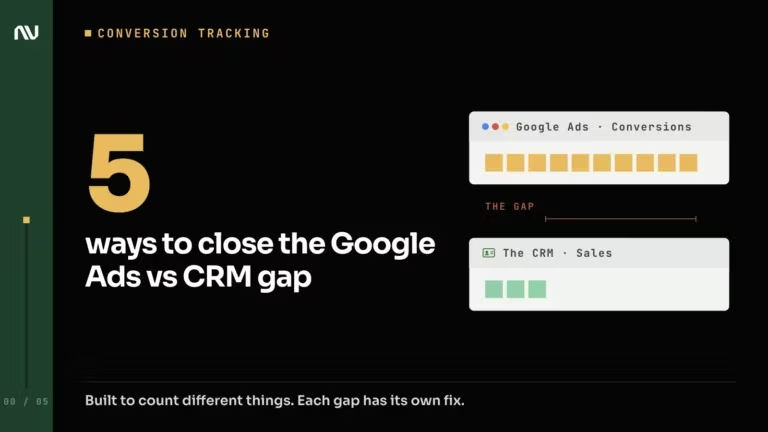
Google Ads conversions don’t match your CRM because they’re built to count different things in different ways, and each gap below has a specific fix

You uploaded the assets Google asked for. Headlines, a couple of images, maybe a video you had lying around. Ad Strength says “Excellent.” And the
Here’s a problem that doesn’t show up until it’s already cost you money. You wire up offline conversion tracking for your bootcamp, you start importing

Cost per lead hides which programs fill seats. Track cost per enrollment per program, import outcomes and calls, and bid on that number.

We tore down the video ads that career, trade, and licensing schools are running right now: the hooks, the structures, and one move to learn from each.
A cheap cost-per-lead can empty a cohort. Map funnel stage values, import them with offline conversion tracking, and bid on enrollments.

You’ve doubled the budget on your best Google Ads campaign and the enrollments barely moved. Your cost per lead crept up. Someone on the team
If you run ads for an online school, a course business, a bootcamp, or a trade school, here’s the short version: Google is changing how
I’ve audited a lot of ad accounts for course creators. eLearning brands, cohort programs, certification schools, the works. And I’ll tell you something I’ve said
Paid advertising for online schools, colleges, and universities, without the guesswork. Quick summary An education PPC agency earns its keep on one thing: tying ad
Unlock Growth: Expert Strategies for Higher Education’s Digital Recruitment Quick Summary / Key Takeaways Precision targeting is paramount: Leverage demographic, geographic, and interest-based targeting to
Quick Summary / Key Takeaways Introduction For nearly a decade, I’ve been deep in the world of online advertising with a focus on Google Ads,
Why good accounts lose money, and the system that fixes it: measurement, structure, and communication. Plus the honest DIY checklist and a 3-pillar audit.
Running Google Ads your California driver’s license school always leads to the same challenge: Most driving schools either oversimplify the math or get lost in
Why Your Ads Might Not Be Working (And How to Fix Them) Imagine you’re running an online school, pumped about your awesome courses. You launch
How can eLearning businesses optimize their customer journey to boost enrollment rates and improve student retention in a competitive 2025 market? n the fast-evolving eLearning
Online education continues to surge in popularity, with e-learning providers in the USA harnessing innovative advertising campaigns to capture learner interest. In 2025, the industry
Most online schools are wasting ad spend. Not because their offer is bad, but because their Google Ads account is structured backward. After helping education
Let’s be honest. For established online schools, having great programs is just the starting point. The marketing landscape is complex, highly competitive, and expensive. Without
Running Google Ads for an eLearning business isn’t the same as selling sneakers or plumbing services. It’s not transactional. It’s trust-based, education-driven, and built around
Most online schools don’t have an ad problem. They have a signals problem. The budget is fine, the programs are good, and the ads run.
If you run an online school or education business, you’ve likely felt it: marketing often feels chaotic. One week leads are flowing. The next week?
Why Smart Educators Are Struggling With Marketing Here’s an uncomfortable truth: most online school marketing is built backward. Schools owners are experts at creating powerful
Why Your Metrics Aren’t Helping You — And What to Do About It If you’re leading an online school or e-learning company, you’re probably already
Let’s be real, running an online school today means putting serious money into ads and platforms, hoping it turns into student enrollments. But here’s the
Why Your Google Ads Feel Like Expensive Guesswork The frustration of rising Google Ads costs without a corresponding increase in enrollments is real. You’re pouring
Ad ROI Is Platform-Agnostic – But Strategy Isn’t Here’s the thing: online schools crushing it with 4x, 5x, or even 6x Return on Ads Spend
When Your Marketing Platforms Tell Different Stories Imagine your marketing dashboards are like independent detectives working the same case. Google Ads says 45 new students
Pouring money into Meta ads for your online school, but seeing no return in enrollments? It’s a frustrating scenario, especially if your Google Ads campaigns
Stop the Revenue Leaks: Retain More Students Every Month Want higher revenue month after month? This listicle delivers seven actionable student retention strategies to keep
For online schools, Google Ads isn’t just an advertising platform — it’s a vital tool for driving enrollments. Understanding how prospective students search for and
If you’ve ever tried to understand or scale your lead generation efforts using GA4 and ended up lost in a maze of tabs, events, and
If you sell online, you’ll want to pay attention to this. OpenAI has just rolled out a major update to ChatGPT: a native shopping experience
If you run an online store and have ever opened GA4 expecting clear answers like: …only to end up buried in tabs and guessing at
Data-driven attribution (DDA) helps marketers understand how different channels contribute to conversions. But implementing it comes with these 5 common data challenges: Quick Comparison Challenge
If your ad ROI suddenly declines, it’s not just frustrating—it’s costly. But here’s the good news: quickly spotting and decisively fixing the issue can help
Data is the lifeblood of modern business, but when it’s scattered across systems, it’s more of a burden than a blessing. Research shows poor data
Allocating your ad budget effectively can boost revenue and reduce wasted spend. Here’s a quick guide to help you make smarter decisions: Quick Tip: Companies
Ad relevance is the key to better ad performance and higher revenue. When your ads align with user intent, you can lower costs, improve engagement,
Running ads for online schools can be challenging, but success boils down to three key areas: Focus on data-driven decisions, clear goals, and compelling messaging
Why Your Online School Needs Conversion Tracking (Even If It Sounds Technical) You’re running ads, writing emails, posting content—doing all the right things to grow
Your Microsoft Ads ad campaigns might be costing you more than they should. High acquisition costs, low conversions, and wasted ad spend can quietly drain
Managing Google Ads on an enterprise level is complex. Enterprise PPC accounts mean juggling massive budgets, multiple regions, diverse product lines, and advanced approaches. Here’s
Want to boost enrollments for your eLearning courses? Google Ads can help. Here’s how you can create campaigns that drive results: Key Tip: Organize campaigns
Looking to boost ROI for your online school from ads? Here’s the quick answer: Quick Comparison Metric Meta Ads Google Ads User Intent Scrolling-focused High-intent
AI is reshaping paid media campaigns by automating processes, improving accuracy, and saving time. Here’s how it’s changing the game: Key Highlights: AI complements human
Cross-channel attribution helps businesses understand how different marketing channels work together to drive customer conversions. With 73% of customers using multiple channels before purchasing, this
It’s easy to get lost in jargon, guru advice, and endless platform updates. Too often, when campaigns underperform, people point fingers at “the algorithm.” But
We just wrapped up 2024 and confirmed that we added another seven figures (millions) to one of our client’s gross profit. Here are the three
Every business faces it at some point—growth stalls, performance plateaus, and your tried-and-true strategies stop delivering. Frustrating, isn’t it? When this happens, many business owners
If you’ve been running Facebook ads for a while, you’ve likely experienced both the highs and lows. At first, it might have felt like magic—sales
Throwing more money into ads seems like the easiest way to grow your business, right? Boost the budget, boost the sales—it sounds simple. But in
Running an online school is no easy task. Between managing courses, serving students, and staying ahead of competitors, it’s easy for marketing efforts to fall
📌 resource: Download the Measurement Framework In today’s digital-first world, businesses are generating more data than ever. Every click, view, and interaction provides an opportunity
The Ultimate GA4 Configuration Health Check: Ensure Your Analytics Foundation Is Rock-Solid Google Analytics 4 (GA4) is a powerful tool for tracking, analyzing, and optimizing
Scaling online course sales with Google Ads isn’t about running random campaigns—it’s about following a proven system. At the heart of this system is understanding
Scaling Pay-Per-Click (PPC) campaigns on Google, Meta, Microsoft ads and other platforms can feel like a cheat code to growing your sales. But when done
Executive Summary Contractors Intelligence School, an online contractor’s school from California, partnered with nn.partners to confront a challenge familiar to many businesses: declining ad performance,
“Facebook ads is just not working for my industry…” That was what my client said when we started on the platform a few months ago.
Not tracking conversions is like driving without a GPS—you might be moving, but are you headed in the right direction? In today’s constantly changing digital
Tracking breakage. Not creative fatigue, not competition, not budget — broken conversion tracking is the #1 silent killer we see in account audits. When your tracking breaks (and it does — browser updates, GTM misconfigurations, platform changes), your bid strategies optimize toward the wrong signals. You end up paying more for lower-quality clicks while your dashboard shows everything is “fine.”
The fix starts with a full tracking audit: verify every conversion action fires correctly, check for duplicates, and confirm your data flows from click to CRM. We’ve seen accounts where fixing tracking alone dropped CPA by 30% — without changing a single ad or keyword.
If your campaigns suddenly stopped performing, start with measurement before you touch anything else. Our 3-Pillar Framework explains why tracking is always Pillar 1. For a deeper dive, read why proper tracking determines your revenue.
Most underperforming accounts share the same structural problem: too many campaigns competing against each other with fragmented budgets. We’ve audited accounts with 50+ campaigns that consolidated down to 5 — and saw ROAS double.
The right structure depends on your business, but the principle is universal: organize campaigns around business objectives and funnel stages, not around individual keywords or products. This gives Google’s algorithm enough data per campaign to optimize effectively.
A strong structure separates brand from non-brand, segments by intent level, and uses shared budgets strategically. It should make scaling predictable — when you add budget, you know exactly where it goes and what to expect.
We cover account structure in detail as Pillar 2 of our methodology. Read how we approach Google Ads account structure, or explore our PPC management services to see how we apply this for clients.
Three red flags: First, they can’t show you exactly which campaigns drive revenue — not clicks, not impressions, actual revenue. If reporting stops at “we got X clicks this month,” that’s a problem. Second, they haven’t touched your conversion tracking setup. An agency that manages ads without auditing your measurement is guessing. Third, no clear account structure rationale — if you ask “why are campaigns organized this way?” and get a vague answer, your budget is being sprayed, not invested.
A well-managed account should show you cost per acquisition at the campaign level, tied back to real business outcomes. You should have dashboard access (not just monthly PDFs) and understand the strategic reasoning behind every dollar spent.
If any of this sounds familiar, a tracking audit is the fastest way to find out where money is leaking. We identify wasted spend before we ever pitch management.
ROAS (Return on Ad Spend) measures revenue generated per dollar of ad spend. If you spend $10,000 on ads and generate $40,000 in revenue, your ROAS is 4x. It’s useful for comparing campaign performance, but it ignores your margins, agency fees, and operational costs.
ROI (Return on Investment) accounts for everything — ad spend, management fees, landing page costs, your team’s time. A 4x ROAS campaign might only deliver 1.5x true ROI once you factor in costs. That might be great for a SaaS business with high lifetime value, or terrible for a low-margin ecommerce product.
The right target depends on your unit economics: margins, customer lifetime value, and growth goals. A “good” ROAS for one business is break-even for another. Read our guide on maximizing ad ROI to see how we calculate targets that actually map to profit, not vanity metrics.
Practical, actionable PPC and analytics content — no fluff, no “10 tips” listicles that say nothing. We write about what we actually do for clients: Google Ads strategy, conversion tracking setup, account structure, Meta Ads troubleshooting, and analytics dashboards that surface real answers.
Our 54 articles span four areas: PPC Strategy (campaign structure, bid strategies, scaling), Analytics & Tracking (GA4, GTM, Data Studio, attribution), eLearning Marketing (student acquisition, enrollment optimization, education-specific campaigns), and Case Studies showing documented client results — like the $10M Google Ads funnel we built for online schools. Every article comes from hands-on experience managing millions in ad spend.
Business owners and marketing leaders at established companies who are already spending on ads and want better results. If you’re managing $30K+/month in ad spend and feel like you’re not getting what you should, this blog is for you.
We don’t write beginner tutorials or generic advice. Our content assumes you understand the basics and want to go deeper — why your campaigns plateaued, how to fix attribution gaps, what account structure actually drives scaling. Whether you run an online school, a service business, or an ecommerce operation, the principles apply.
Think of it as the strategic thinking we share with clients, published for anyone serious about making their ads profitable. Start with our 3-Pillar Framework — it’s the foundation behind everything we do.
We publish new articles regularly, focusing on depth over frequency. Every piece is based on real campaign data, client work, or emerging platform changes — not content-calendar filler. When Google rolls out a new feature, when we discover a pattern across client accounts, or when we solve a problem worth documenting, it becomes an article.
Recent topics include ChatGPT Shopping’s impact on advertisers, the GA4 dashboard that actually gives answers, and diagnosing why ad ROI drops. Subscribe or check back to stay current on PPC strategy and analytics insights that go beyond surface-level advice.
Absolutely — that’s the point. Every article includes specific, implementable advice. Our account structure guide walks through exactly how we organize campaigns. Our attribution guide explains how to set up measurement that tells you what’s actually driving revenue. The GA4 dashboard article includes the exact report layout we build for clients.
That said, there’s a difference between knowing what to do and having the time and expertise to execute it consistently. If you’d rather have a team handle the optimization while you focus on running your business, see how our PPC management works — or start with an account audit to see where the biggest opportunities are.