BigQuery Cost for Marketing: Price, Team, First 30 Days

BigQuery cost for marketing has 3 parts. Google’s bill is often the smallest: about $0 to $25 a month set up well in our worked example, since the first 1 TiB of queries and 10 GiB of storage are free monthly. Connectors add $20 to $620 a month by ad spend. The build and people cost the most. BigQuery is Google’s data warehouse, where ad spend, calls and CRM deals sit together in your own project. Below: each part priced, then the time, the team, build or buy, and a 30-day plan.
New to the topic? Start from the top: what BigQuery is.
 Plays from YouTube, which may set cookies.
How much does BigQuery cost for marketing?
Set up well, about $0 to $25 a month in our worked example below. Past the free tier, on-demand queries list at $6.25 per TiB, and Google’s page says “For 1 TiB for a full month, you pay $23.552 USD” for active storage. Your dashboards decide which end of the range you land on.
| Monthly ad spend | $30K | $100K | $250K |
|---|---|---|---|
| Our assumptions: GA4 events a day, and dashboard loads a day if dashboards read raw tables | 30,000 events, 10 loads | 100,000 events, 20 loads | 300,000 events, 40 loads |
| BigQuery bill at month 12, set up well (partitioned tables, dashboards read daily summaries) | about $0.15 | about $4 | about $25 |
| BigQuery bill at month 12, each dashboard load reads the whole raw GA4 table | about $9 | about $94 | about $586 |
| Connectors beyond Google’s free ones (Meta, CRM, calls; Microsoft Ads from $100K) | about $20 to $40 | about $30 to $210 | about $200 to $620 |
Our worked example from list prices, checked 19 Oct 2026. The volumes are our assumptions, so measure your own GA4 export in week 1 before you trust any number. The gap between the 2 BigQuery rows comes from one thing: dashboards that read raw tables all day. A vendor example for a bigger setup, 5 platforms and 10 ad accounts, tells the same story at a higher level: $30 to $80 a month optimized and $400 to $600 unmanaged by month 3 (Dataslayer, 2026).

Some of it costs nothing. Google Ads, GA4 and YouTube transfers carry no charge, and you aren’t charged for queries that return an error or come from the cache. Tables untouched for 90 days drop to long-term storage, about $0.016 per GiB a month against about $0.023 for active. For heavy, steady use, the Standard edition lists at $0.04 per slot-hour with no commitment.
You can test before you pay anything. The BigQuery sandbox works without a credit card, and its tables expire after 60 days.
Can I get a surprise bill, and how do I stop it?
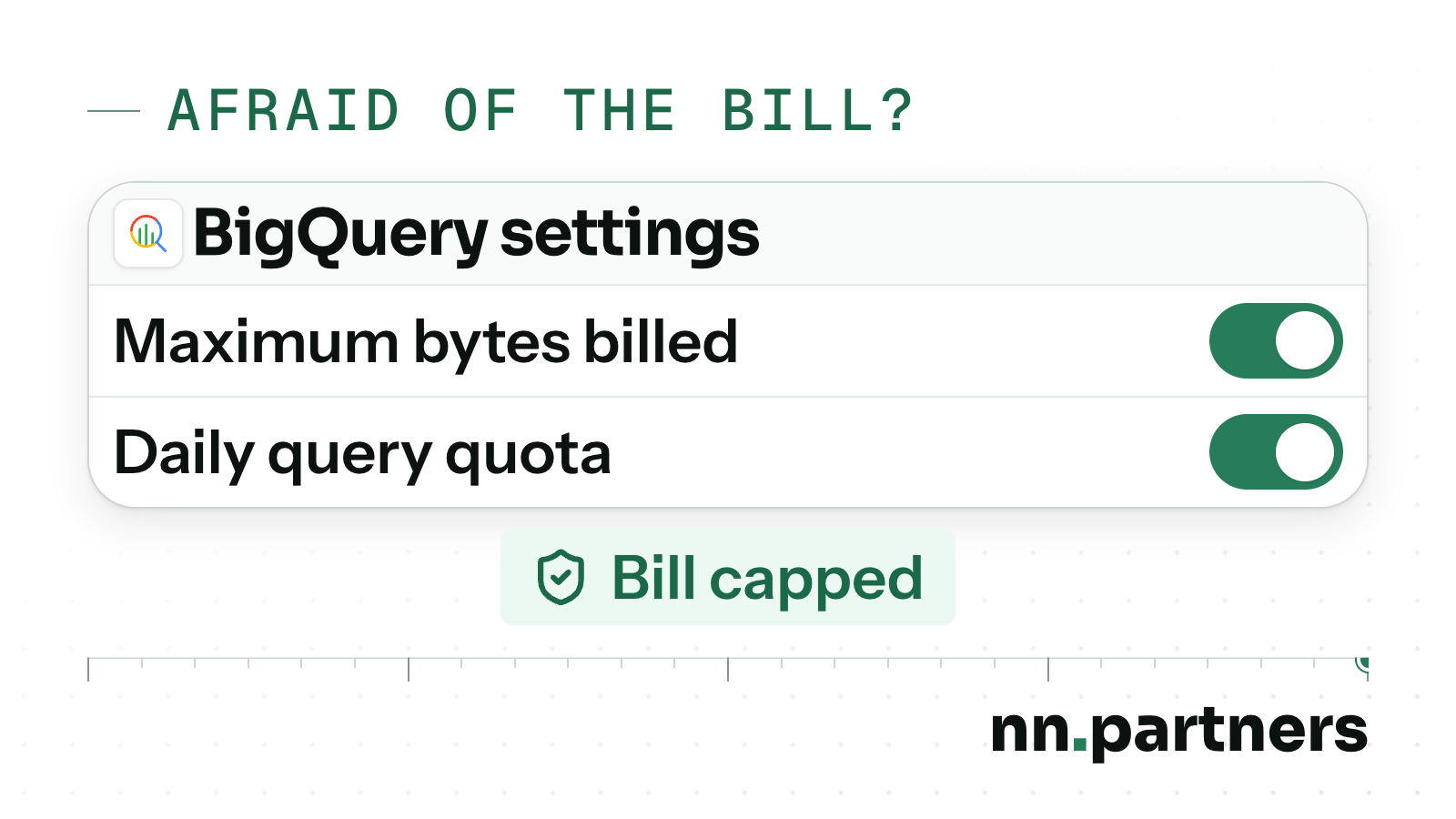
Yes. Google’s default daily limit is high: 200 TiB of queries per project, about $1,250 a day at list price. In February 2024 one user was billed $14,000 in about 2 hours after running queries on a public web dataset. The 2 switches below cap a bill like that. Turn both on before your first query.
First, set a maximum bytes billed. Google’s best-practices page says: “If the number of estimated bytes is beyond the limit, then the query fails without incurring a charge.”
Second, set a custom daily quota. It works like this, in Google’s words: “you can’t run an 11 TB query if you have a 10 TB quota.” Set your own lower number on day one.

If you spend $30K or more a month on ads and want these switches checked on your own setup, you can ask for a Data Audit. We look at what you have within 48 hours, then walk you through it on a 20-minute call.
What does the whole build cost beyond BigQuery?
More than BigQuery itself. Connectors run from free to $600 a month and up at list price. The build and the people cost the most: a generic mid-size warehouse build runs EUR 20,000 to 60,000 in one 2026 estimate, and one data engineer EUR 70,000 to 95,000 a year, loaded.
| Layer | What it costs | Source type |
|---|---|---|
| BigQuery queries and storage | Free to 1 TiB of queries and 10 GiB of storage a month; then $6.25 per TiB queried and $23.552 per TiB stored a month | Google list price, pricing page |
| Dashboards | About $87 a month for one dashboard on an unpartitioned table, about $1.30 once partitioned; in a worked example, dashboard refresh fell from $350 to $8 a month | Vendor example (Dataslayer, 2026) |
| Connectors | Google Ads and GA4 transfers: no charge. Fivetran free to 500,000 monthly active rows; its example Google Ads connection of 88,240 rows lists at $48.67 a month. Windsor.ai from $19 billed yearly or $23 monthly; Airbyte Cloud from $20; Supermetrics from EUR 39 a month billed yearly; Funnel from $300 a month billed yearly | Google and vendor list prices |
| Build and people | A generic mid-size warehouse build EUR 20,000 to 60,000 over 8 to 16 weeks; a data engineer EUR 70,000 to 95,000 loaded a year; enterprise GA4 and basic Google Marketing Platform setups $25,000 to $75,000, retainers $12,000 to $50,000+ a month | Market anchors: Kolonell and Adswerve via Vendr |
Last checked: 19 Oct 2026. Kolonell describes a generic mid-size build for any type of data, and the Adswerve figures are an enterprise benchmark. Connector prices move with your row count, and Supermetrics and Funnel do not say which plan includes BigQuery. We do not publish our build price here; it is set after the Data Audit.
How long does it take?
A generic mid-size warehouse build takes 8 to 16 weeks in one published 2026 estimate. Our own service page says a marketing data warehouse is live in a few weeks, with 30 days to judge it. Your access and your CRM set the real date.
Who do I need on the team?
You need someone who owns the model and the guardrails, plus the access owners on your side. The Data Manager link to Google Ads needs GCP owner access on the BigQuery dataset and Google Ads admin access. A hired data engineer costs EUR 70,000 to 95,000 loaded a year in one estimate.
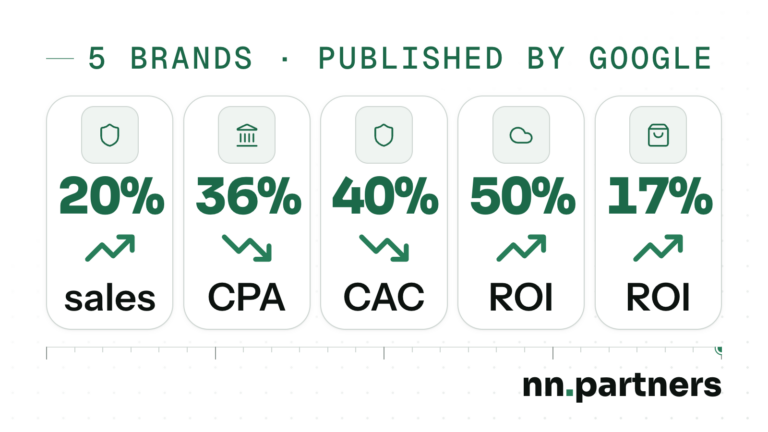
An in-house team can do it. Millennium bcp, a Portuguese bank, ran its campaign with a 100% in-house digital marketing team, and its own result, published on a Google Cloud customer page, reads: “In paid media, conversion volume doubled, conversion rates were 1.9x higher, and the CPA dropped by 36%.” The comparison is with its other first-party audiences. More cases are in the proof article.
Our own team works with GA4, Google Tag Manager and server-side GTM on Stape and Google Cloud, Google Ads, Meta Pixel and Conversions API, Microsoft Ads, CallRail, BigQuery and Data Studio (formerly Looker Studio), plus consent tooling. This is our data strategy and BigQuery setup work.
How we put it to clients: “If you have questions about data management, if you have questions about source of truth, we want to be the partner who supports you with that. You can come to us and say, where do I find this? Or what should I trust? Or how do we distinguish between organic and paid? It may be exhaustive, and you can tell us that: can you simplify it?”
Should I build in house, buy a connector, or hire an agency?
Build in house if you already employ a data engineer. Buy a connector if you only need the pipes. Hire a partner if you want the model, the guardrails and the closed deals sent back to Google Ads handled for you. A connector moves data; you still decide what counts as a closed deal.

| Build in house | Connector tool plus your team | Agency or partner | |
|---|---|---|---|
| What you pay for | Salaries: EUR 70,000 to 95,000 loaded a year for one data engineer | A connector plan: free to $600 a month and up (see the table above) | A project fee or retainer; the market anchor is $25,000 to $75,000 setup at the enterprise end; ours is set after the Data Audit |
| Who owns the model and guardrails | Your engineer | You | The partner |
| Who sends closed deals back to Google Ads | You build it | You build it; the connector moves the data | Part of the build |
| Main risk | Key-person risk | Dashboards with no CRM join | Lock-in, unless the data stays in your own project: Google states “You own your data, not Google” |
| Time | 8 to 16 weeks, a generic anchor | Set by your team’s time | A few weeks on our service page, 30 days to judge |
What the connector-only path looked like on one setup our team reviewed:
We noticed a lot of data sources that were idle, which clunks the whole thing. There were Google Sheets sources used there. It usually takes a toll on the connector tool’s usage, which affects your monthly billing. And it creates friction and makes reports, here for example in Data Studio, slower and less reliable. Sometimes it won’t load because of how it’s currently done. With that component we could hit two birds with one stone: create a single source of truth, a data warehouse and a blended report in Data Studio.
Microsoft Ads needs a third-party tool: Google’s Data Transfer Service page lists no Microsoft Ads connector, and Supermetrics offers that transfer. Our own version is a marketing data warehouse built in your own BigQuery.
What should happen in the first 30 days?
Week 1 sets access, guardrails and the exports. Week 2 brings in CRM and call data. Week 3 reads cost per sale by campaign. Week 4 sends closed deals back to Google Ads. Treat it as a plan; your access and your CRM set the pace. The full flow is in the click to closed deal setup.

| Week | What happens |
|---|---|
| 1 | Data Audit, access, guardrails on (byte cap, daily quota), GA4 daily export linked, Google Ads transfer set |
| 2 | CRM and call data in; the GCLID field checked |
| 3 | Cost per sale by campaign in Data Studio or Sheets |
| 4 | Closed deals sent back to Google Ads through the Data Manager; first read of what bidding now learns from |
What do I need ready before day one?
You need 6 things: a Google Cloud project with billing and an owner, Google Ads admin, GA4 admin, CRM admin, your call-tracking login, and a written rule for what counts as a closed deal and what it’s worth. The CRM also needs a field that stores the GCLID, the click ID of each lead.
That ID is how the sale finds its ad. Google’s page says “you give that GCLID back to Google Ads along with a few details about the type of conversion it was and when it happened.” The step by step is in the click to closed deal setup.
How do I know it is working?
3 signs tell you it works. Google Ads data lands every day. Cost per sale by campaign reads in one report. Closed deals show up as conversions in Google Ads. If one of the 3 is missing after week 4, the setup is not finished yet.
On freshness, Google’s page says “By default, the Google Ads connector has a refresh window of 7 days.”
Fine print: no setup matches every sale. Phone sales without a tracked number, consent opt-outs and cross-device journeys leave gaps; a typical match is 80 to 95% of CRM sales.
What mistakes cost the most?
Paying for columns you never needed. Adding LIMIT to a query does not lower the bill, because Google’s page says “you’re charged according to the data processed in the columns you select, even if you set an explicit LIMIT on the results.” Select only the columns you use.
- Unpartitioned dashboard tables. In one vendor example a dashboard table fell from about $87 a month to about $1.30 after partitioning and clustering (Dataslayer, 2026).
- Retraining models more often than you need. BigQuery ML model creation lists at $312.50 per TiB on the pricing page, 50 times the on-demand query rate.
- Streaming the GA4 export for money reports. Streaming costs $0.05 per gigabyte and runs best effort, with no completeness guarantee. The daily export is the raw, unsampled record.
- Views as upload sources. The Data Manager needs fully authorized views, with no external tables.

If you spend $30K or more a month and want a cost and a plan for your own setup, ask for a Data Audit: we check what you have within 48 hours, then walk you through it on a 20-minute call. Prefer to pick a time? Book it here.
See how we build it: a marketing data warehouse built in your own BigQuery. Or start from the top: what BigQuery is.
Frequently asked questions
Is the BigQuery free tier enough for a marketing team?
Often for a pilot. Dashboards that refresh all day are what push most teams past it: in one vendor example, dashboard refresh was $350 of a $515 month.
Why do the cost estimates online differ so much?
They describe different setups, and most come from vendors who sell the tools. The same workload ranges from $36 to $515 a month in one vendor’s own example, depending on optimization. Ask for the assumptions behind any number, the way our table above states ours.
Do I need a data engineer on staff?
Not to start. You need someone who owns the model and the guardrails, in house or a partner, and the access owners on your side.
Is Supermetrics or Fivetran enough on its own?
A connector moves data. It does not decide what counts as a closed deal or send it back to Google Ads. Many setups use a connector for the pipes and BigQuery for the join.
Am I locked in to Google?
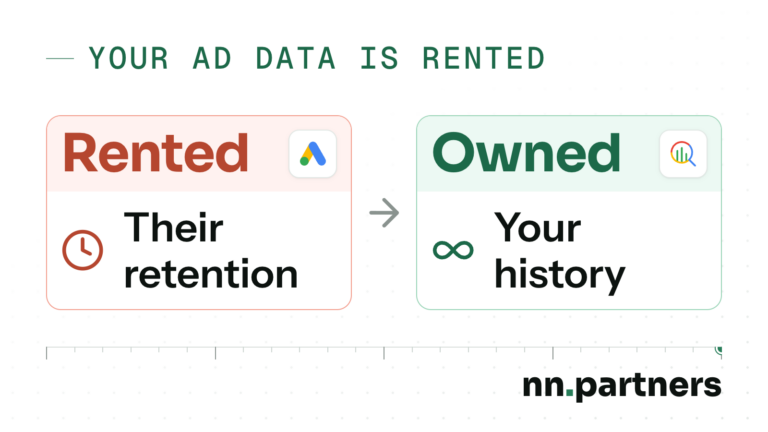
The data sits in your own Google Cloud project, and Google states “You own your data, not Google.” We found no independent source on switching cost, so we do not put a number on it.
What does nn.partners charge?
Priced after the Data Audit, once we know your sources, your CRM and your spend. Ask for a Data Audit and you get the number for your own setup.
Written by Nik Vdovenko, founder of nn.partners (Google and Meta Partner, top 1% of PPC agencies on Upwork, 9 years, $10M+ ad spend managed), and the nn.partners team.
Researched by the nn.partners team from Google’s own documentation and the named case studies. Every number links to its source. Prices checked 19 Oct 2026.
Last checked: 19 Oct 2026.
Sources
- BigQuery pricing
- Google Cloud free features
- BigQuery sandbox
- Controlling BigQuery costs
- Custom quotas
- Google Ads transfers
- GA4 BigQuery export
- Data Manager BigQuery connection
- Dataslayer, BigQuery costs for marketing teams, 2026
- Kolonell, SME data warehouse setup cost, 2026
- Vendr, Adswerve pricing
- HTTP Archive forum, the $14,000 charge (Feb 2024)
- Millennium bcp, Google Cloud customer page