Your Ad Data Is Rented. BigQuery Is How You Own It

BigQuery for marketing means keeping your own copy of ad, analytics, call and CRM data in one Google Cloud project you control. Teams use it to join ad spend to closed deals, keep the detailed history the platforms drop, and send real sales back to Google Ads.
If Google Ads, GA4 and your CRM each show a different number, this guide shows why, what BigQuery adds, what it costs to start, and when a business spending $30K or more a month on ads needs it.

 Plays from YouTube, which may set cookies.
Why do Google Ads, GA4 and my CRM show different numbers?
Each tool counts by its own rules. Google Ads credits a conversion inside its attribution window. GA4 fills data gaps with modeling when consent mode is on. A CRM only knows what a person or a script put into it. Three tools answer three different questions, so the answers differ.
On a client review call, Nik put it like this:
Conversions are missed due to various reasons, like the conversion attribution window and the orders by admin [orders an admin enters by hand]. But what we identified was that in the current CRM you are storing the hard coded UTMs, and it helps to have better visibility as to how various sources are performing.
In an illustrative example from a vendor, DarwinApps, GA4 credits organic search with 40% of conversions while the CRM credits direct referrals with 60% of closed-won revenue. Attribution tools carry a bias of their own. On another call, about one such tool:
They have this in their documentation, the way they treat sources. They say it very explicitly that they prioritize paid traffic. Which is why, for the whole funnel attribution, this platform is not ideal.
What does it mean that your ad data is rented?
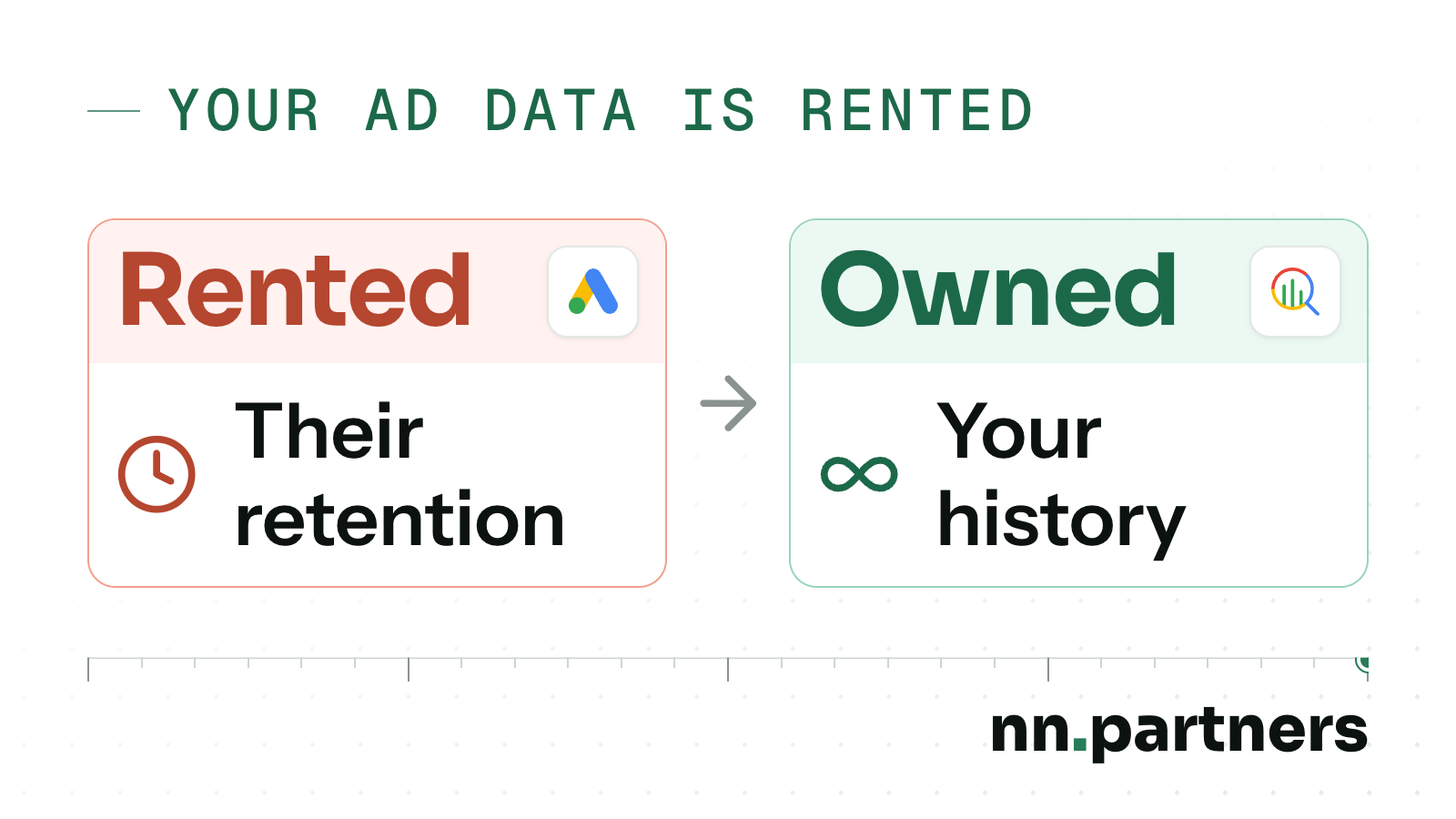
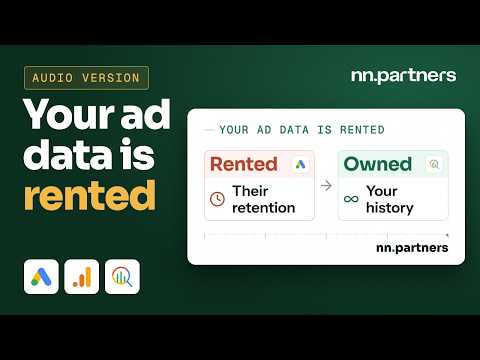
Rented means the platform decides how long you can see your data and in what shape. Since 1 June 2026, Google Ads keeps hourly, daily and weekly data for 37 months. GA4 explorations hold event data for 2 or 14 months on standard properties.

| Where the data sits | Kept or capped | Source |
|---|---|---|
| Google Ads, hourly, daily and weekly data | 37 months, since 1 June 2026 | Google Ads Help |
| Google Ads, monthly, quarterly and annual data | 11 years | Google Ads Help |
| GA4 explorations, standard property | 2 or 14 months, your setting | Analytics Help |
| GA4 explorations, 360 property | Up to 50 months | Analytics Help |
| GA4 daily export to BigQuery, standard property | Capped at 1 million events a day | Analytics Help |
| Your BigQuery project | You decide; sandbox tables expire after 60 days | BigQuery docs |

The GA4 setting only affects explorations and funnel reports. Google Cloud says of data you put in its products: “You own your data, not Google.”
If your reports disagree and you spend $30K or more a month, request a Data Audit: we map where your numbers split within 48 hours, then walk you through it on a 20-minute call.
What is BigQuery, without the jargon?
BigQuery is a fully managed data platform from Google. It is serverless: “You don’t need to provision individual instances or virtual machines to use BigQuery.” Storage and compute are separate layers and are billed apart. You load data in, query it with SQL, and keep the rows as long as you choose.
The ad platforms rent you a furnished apartment. BigQuery is the house, with your own keys. That is where our data strategy and BigQuery setup work starts.

| Tool | Its job |
|---|---|
| Google Ads | Buys clicks and reports platform conversions |
| GA4 | Collects website and app events |
| CRM | Holds leads, calls, deals and revenue |
| BigQuery | Stores all of it and joins it |
| Data Studio or Connected Sheets | Shows the result as charts or pivot tables |
What can BigQuery do that Google Ads and GA4 cannot?
It puts ad spend, web events, calls and CRM deals on one row, which no single ad platform report does. It keeps GA4’s raw event export and can send closed deals back to Google Ads. Google Ads and GA4 data come in through Google’s own connectors, listed as “No charge”.
- Join. One query reads spend from Google Ads, sessions from GA4 and deal value from your CRM, so you see cost per sale next to cost per click. Piece 2 shows how one ad click becomes a closed deal.
- Keep the raw export. GA4’s daily export sends “all the raw, unsampled event data once per day”. With consent mode on, cookieless pings are in it too.
- Send sales back. Google Ads Data Manager can upload data from BigQuery for Enhanced Conversions for Leads, then reuse the connection for Customer Match.
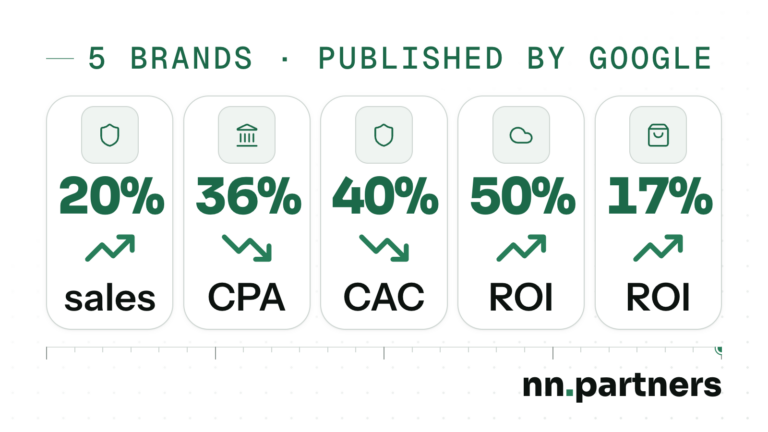
Millennium bcp, a Portuguese bank, published its own result on a Google Cloud page: in paid media, conversion volume doubled and CPA fell 36%, compared with other first-party audiences. It ran BigQuery ML audiences with an in-house team. More in our BigQuery marketing case studies by industry.
Is BigQuery the same as Looker Studio (now Data Studio)?
No. BigQuery stores and joins data. Data Studio draws the charts and tables from it. Google renamed Looker Studio to Data Studio in April 2026, as its announcement of 11 April 2026 shows, so older guides still use the old name.

- Data Studio connects to BigQuery, and BI Engine speeds up the reports. A chart shows at most 5,000 rows.
- Connected Sheets runs pivot tables on the full data set, though the sheet previews only 500 rows.
Do I need a data warehouse at $30K a month in ad spend?
Probably, if 2 or more of these are true: sales close by phone or in a CRM, you run more than one ad platform, your reports disagree, or you need history older than 14 months. We found no published spend threshold, so go by symptoms.
- Sales close by phone or in a CRM, outside the ad platform.
- You run more than one ad platform.
- You argue about which report is right.
- You need history older than 14 months.
- Your site sends close to 1 million events a day, the export cap on a standard GA4 property.
With 2 or more points ticked, look at a marketing data warehouse in your own BigQuery.
What happens to my history if I wait?
It ages out. The Google Ads transfer into BigQuery retrieves data “as far back as the data retention policy on your data source allows”, and that source now keeps granular data for 37 months. Each month you wait costs you one month at the old end.
- Google Ads granular data: 37 months, then gone from the account.
- GA4 explorations on a standard property: 14 months at most.
- Exported GA4 data is a one-time copy. GA4’s own page states: “Once you export data from Analytics to BigQuery, you cannot re-export it.”
Data that arrives through a transfer is billed at standard BigQuery storage and query prices, so the cheap first step is to switch on the Google Ads transfer and the GA4 export.
What does BigQuery cost to start?
The first 1 TiB of queries and 10 GiB of storage each month are free. After that, on-demand queries cost $6.25 per TiB, list price in US regions. The sandbox needs no credit card, but its tables expire after 60 days.
- The sandbox has no streaming, no DML and no Data Transfer Service, so use it to test and move to a billed project before you keep real history.
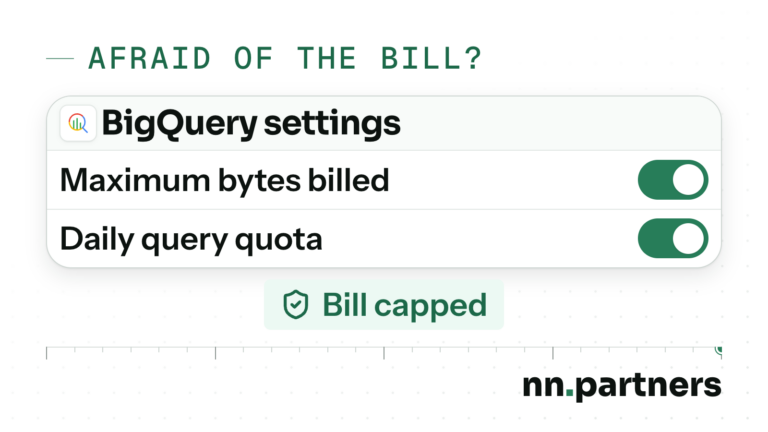
- Set a maximum bytes billed: “the query fails without incurring a charge” when it would go over.
List price checked 19 Oct 2026; check Google’s pricing page. Connectors, the build and the people cost more than BigQuery itself. See what BigQuery costs for marketing, all in.
What does BigQuery not do for you?
It does not fix tracking: bad events in means bad rows stored. It will also not match the GA4 screen number for number. Google’s export page lists cookieless pings, and we found no statement that modeled conversions are in the export. Someone has to own the model and the guardrails.
BigQuery data needs care too: rows can change after the fact, for example when orders are canceled. From a client call:
We are pulling the data from the database in Google BigQuery, but it looks like the table is updated sometimes. So maybe some orders are canceled.
The point is to make sure that we have enough information and the data is clear and good, so that you could make budgeting decisions.
So fix the tracking first, then store it.
Reports still disagree at $30K or more a month? Ask for a Data Audit, or book a call.
Next: follow one ad click to a closed deal.
Frequently asked questions about BigQuery for marketing
Is BigQuery free?
It has a free tier: the first 1 TiB of queries and 10 GiB of storage each month. Sandbox tables expire after 60 days, so keep real history in a billed project.
Do I need to know SQL to use BigQuery?
Someone on your team or your partner writes the queries once. You read the results in Data Studio or in Google Sheets. Gemini in BigQuery helps with SQL, and some of its features are in Preview.
Is my data safe in BigQuery?
BigQuery encrypts content at rest by default, and you can add your own keys. For a named certification such as HIPAA, check Google Cloud’s compliance resource center.
What is the difference between BigQuery and GA4?
GA4 collects site and app events and reports on them. BigQuery holds the raw, unsampled event export plus anything you add, such as ad spend and CRM deals.
Can BigQuery hold Meta and Microsoft Ads data too?
Meta, yes: Google’s transfer service has a paid Facebook Ads connector. Google’s list of transfer sources had no Microsoft Advertising connector on 19 Oct 2026, so a vendor tool such as Supermetrics moves that data.
Is BigQuery worth it for a small business?
There is no size floor. Small tables fit inside the free tier. It pays off when sales close outside the ad platform and a wrong channel decision costs real money.
By Nik Vdovenko, founder of nn.partners (Google and Meta Partner, top 1% of PPC agencies on Upwork, 9 years, $10M+ ad spend managed), and the nn.partners team. Researched by the nn.partners team from Google’s own documentation and the named case study. Every number links to its source. Prices checked 19 Oct 2026.
Last checked: 19 Oct 2026 (prices, limits and retention periods).