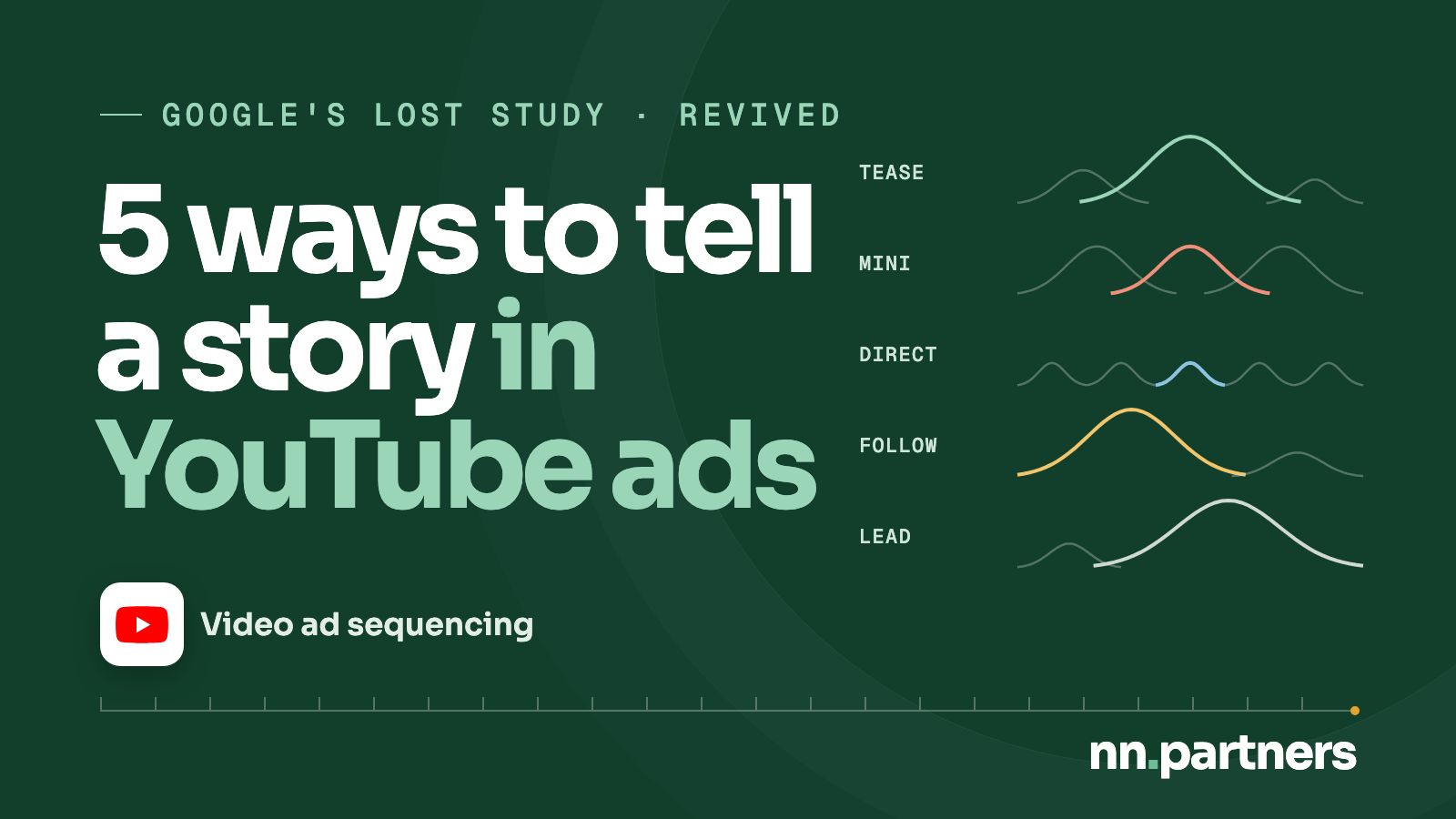
The best lesson on YouTube ads I ever read. Google deleted it, so I rebuilt it

 Plays from YouTube, which may set cookies.
Google’s 2019 interactive study “Why you remembered that YouTube ad”, rebuilt from the archived code, data and videos. Where an ad is gone, we show the closest real footage we found and say where it comes from.
Why I rebuilt this page
I came across this page four or five years ago, and it changed how I look at media.
My background is direct response. Search ads, where people already know what they want and type it in. Top-of-funnel awareness always looked like the opposite: hard to measure, subjective, secondary. And search behavior kept growing year over year, with no sign of stopping.
Then I saw how 20th Century Fox and Google promoted movies on YouTube.
A product is one thing. It has clear selling points and a set of features, and you translate those into a message. Promoting a movie is a completely different fruit. You’re telling a story about a story.
Seeing that logic laid out, ad by ad, changed what I thought top-of-funnel campaigns could do. In one short page it unpacked how to tell a story, how to talk about a brand, and how to do both in a way that works.
Then Google took the page down, and the lessons went with it.
So I restored it: the five sequences, the real ads we could still find, and Google’s data. Use it for whatever you’re promoting.
Five tested video ad sequences
Since I found this page, I’ve used almost every sequence in it. The two I love most are tease, amplify, echo and the mini series.
Google and Ipsos tested each shape on 7,500 people in the US, against one 30-second ad shown twice. Every block below has my take, the shape, the real Fox ads Google used to show it, and how it scored. Press play once and the ads run in order, the way a viewer meets them.
Tease, amplify, echo
Open with a short ad that raises a question. Follow with a long ad that tells the story. Close with a short ad that reminds people and asks them to act.
This is the one we recommend to most advertisers who want to start with video ads. It’s easy to plan and easy to follow over time. Make the teaser a skippable ad that runs past the skip button, so you capture the people who chose to watch it. Then show them the amplify and the echo. It’s the simplest way to plan a video campaign, and a very strong instrument.
- 6 s
- 30 s
- 6 s
- Tease 0:30
- Amplify 1:27
- Echo 0:20
Fox wanted people to meet a new character and buy a ticket. They built four versions of a three-ad sequence: for men, for women and for all adults. Every ad was skippable, and the next one only showed once the last had been served. Brand Lift surveys picked the winner, and Fox put the budget behind it.
- What worked
- Plain scenes lifted straight from the film. The long ads drove higher engagement and intent across the board.
- Result
- A significant lift in consideration.
Mini series
Split the story into chapters told over time: set up the conflict, show the peak, resolve it. Each ad gives a reason to watch the next one.
The mini series unpacks a complex product, a complicated set of services or a long list of selling points. Each chapter is one mini story, and the format guides people through the whole set on its own.
- 6 s
- 6 s
- 6 s
- Chapter 1 0:25
- Chapter 2 0:45, or 0:15 after a skip
- Chapter 3 short
For the digital download release, Fox let the sequence react to each viewer. Deadpool talks straight to the camera, so even a skip became part of the joke. Pick what one viewer does and see what they got next.
The Fox article gives the chapter 3 rule for people who saw the new scene; for people who skipped chapter 1 we show the same rule.
- Goal
- The best digital download conversion rate for an action film in Fox’s history.
- Result
- Goal reached. YouTube Works 2019 winner: 60% view-through rate on the final piece and 198% more organic searches for the title.
Take a home improvement business. One of its selling points is premium materials. In a general ad that line sits next to everything else: “We’re certified, we do this kind of job and that kind of job, and we use premium materials, so get in touch.” It doesn’t mean anything. It doesn’t say anything.
The mini series lets you say it. One ad is only about the materials: what makes them premium, what makes them special, and why you chose them over others. The next ad is about certifications: why people overlook them, how yours set you apart from providers who can’t match them, and how a buyer can pick the best option. Each can be a normal 20 or 30-second ad. Split into a mini series, they unpack complex information and tell a story that makes a difference.
The Deadpool series mixed short and long pieces. What tied them together was one story told from different angles. That’s what I’d copy.
Direct shot
Several short ads that make the same point from different angles. Google suggested four to six.
I’ve tried this one the least. Six seconds is tight, and most advertisers struggle to pack their message into a bumper. The Predator bumpers work because so much happens in each one: anticipation, surprise, action. It’s an interesting format, and very underused.
One technical catch: bumpers can’t be skipped, so in Google Ads a direct shot can only move to the next step on impressions. View and skip steps need skippable ads.
- 6 s
- 6 s
- 6 s
- 5 bumpers 0:06 each
The film struggled in cinemas, so the job at home was to reach people who had missed it. Fox ran five 6-second bumpers in a row against one skippable ad. Each showed a different moment and ended on the same line: out now on Blu-ray, DVD and digital download.
- Result
- Higher purchase intent than the single skippable ad. Fox read it as a sign that variety plus frequency can beat frequency alone.
Follow-up
Start with the full story in a long ad, then follow with a shorter ad that keeps it alive and moves people to act.
A shorter tease, amplify, echo. You open with a long skippable ad that people choose to watch. Then you show them short follow-ups that remind them what they watched and invite the next step.
- 30 s
- 6 s
- Long 0:30
- Short 0:20
Lead-in
Open with a short teaser, then finish with a long ad that completes the story and carries the call to action.
The other half of tease, amplify, echo. You tease people with a preview of what’s coming, then, on the conditions you set in the account, show them the long piece. A very interesting concept, and not widespread.
- 6 s
- 30 s
- Short teaser
- Long 0:45
Which sequence should you start with?
Pick a goal. Each small dot is one campaign from the test. The big dot is the result for everyone who saw that sequence, so it won’t sit in the middle of the small ones. The higher the dot, the more the sequence beat the single ad.
Swipe the chart to see all five sequences.
How to run video ad sequencing in Google Ads today
The campaign still exists in Google Ads, as a type of Video campaign. Here’s how it works today (Google’s help pages, checked 23 Oct 2026):
- Templates at setup: Introduce & reinforce, Prompt & inspire, Attract & direct, Engage & differentiate. You can also set your own order.
- Each step moves on when the viewer gets an impression, a view or a skip of the step before.
- Steps can use skippable, non-skippable or bumper ads, and the campaign bids on Target CPM.
- One sequence per person every 7 days by default, or every 30 days.
- Targeting is audiences and demographics at campaign level, on YouTube only. No keywords, placements or topics.
Source: About video ad sequencing, Google Ads Help.
Where I’d start
Start with tease, amplify, echo, the mini series, or both. They teach you fast how to sequence a message.
People are all over their feed. They have very little time, they’re doing ten things at once, and they aren’t scrolling to see an ad. So tease them with something interesting and relevant to what you do. Some will respond. Follow up with a longer piece for those who showed interest but weren’t convinced yet. Then, for the ones who took a few steps but need a final nudge, send one more short follow-up. That simple sequence is a very powerful way to get started.
If your product has many features that could each be their own ad, run it as a mini series, one feature per chapter.
One warning: don’t overcomplicate it. You never know what will work until your ads are in the market, and the only judge is the people who watch them. I’d much rather make a batch of three variations of each teaser and each chapter, even about the same message, than chase the perfect 30-second shot, the perfect 60-second shot or the perfect bumper. The more you experiment, the faster you find the combination that works.
What the data says
Three ads beat two
Three-ad sequences got 96% more ad recall lift and 133% more purchase intent lift than the single ad. Two-ad ones got 41% and 63%. The two-ad group was only follow-up and lead-in, so shape and length are mixed here.
Bumpers did most of the work
Every tested sequence used 6-second bumpers, and two used nothing else. None had more than one 30-second ad, and all of them were cut from a single existing ad.
Watch the Deadpool campaign
The Deadpool 2 sequence won at Google’s YouTube Works awards in 2019. The case film shows the ads the way viewers met them: the chapter 1 cut, the popcorn spot, the Super Duper Cut scene and the skip message.
Want help planning your first sequence?
My team and I build the tracking, the audiences and the creative that a sequence runs on. Book a call and we’ll map your first one.
Book a call- Think with Google, “Why you remembered that YouTube ad” (interactive feature, 2019), rebuilt from its archived app, code and data. Data: Google/Ipsos lab experiment. US: n=7,500 people aged 18 to 64, Nov. 2018. UK, Germany, Brazil, Mexico and Japan: Apr. to May 2019; Google’s page gives n=3,000 per country in one place and n=1,000 in another.
- Chris Spelman and Jason Runyan, 20th Century Fox, “It’s time to reinvent the way stories are told. Here are 3 proven approaches to try”, Think with Google, July 2019.
- Par Ljungstrom, “How Sequencing Ads Drive Impact”, Ipsos, May 2019.
- YouTube Works 2019 winner film: Twentieth Century Fox Home Entertainment, Think Jam and Mindshare.
- Ads: 20th Century Fox U.K. and Fox Home Entertainment U.K. (now 20th Century Studios). The Alita ads play from the 20th Century Studios UK YouTube channel. The Deadpool 2 scene ad and the Predator “Hunting” bumper are copies recovered from the Internet Archive’s copy of Google’s page. Cards marked “Case film” are parts of the YouTube Works film with its narration removed; which Deadpool spot sat in which slot is our reading of that film. The 15 s skip ad plays from an upload by Campaign magazine. Cards marked “Stand-in” are official 6-second bumpers for the same film from 20th Century Studios Latin America (cinema release); the four tested home-release bumpers were removed and no copy survives that we could find.
- An independent rebuild for study. Not made, checked or endorsed by Google, Ipsos or 20th Century Studios.