4 Reasons Google Wants You on AI Max for Search (and How It Actually Works)

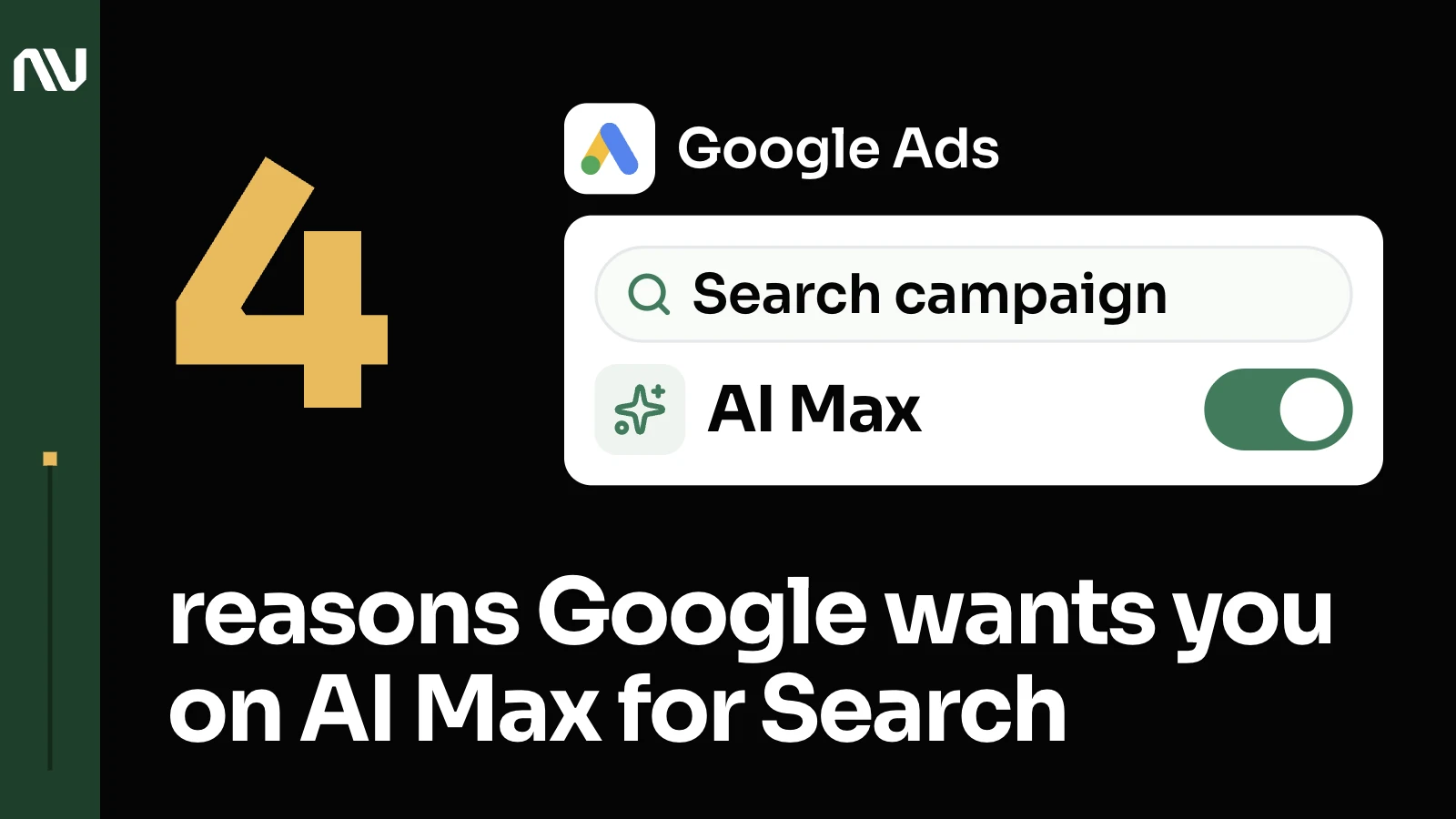
The way Google was operating even two years ago and the way it works now is very different, to say the least. What works well across a very diverse range of customers, predominantly in the United States, is broad match as a keyword match type, very precisely set up conversion tracking that is perfect. Google wants you on AI Max because it typically finds more of the searches your keyword list is missing, matches your ad and landing page to what people actually typed, runs itself instead of asking for a rebuild, and still leaves you the controls to keep it on brand, if you use them.
1. AI Max finds search queries your keyword list is missing.

On Google, a lot of things are changing, and in the accounts we manage we’re trying to move with the flow, a little ahead of the curve. We have AI Max campaigns, we’ve had them set up for a while by now, and AI Max is one of the tools for us to be visible in the AI overview. Whenever people search on Google now, most of the time they’re offered the AI overview instead of a page of links. That campaign setting lets us capture the new people engaging with Google through the AI overview. What we expect from the platform is that the old campaign structure we used to rely on will gradually merge with AI Max, and I think it’s actually a good thing, because of how people use the technology now. People are being descriptive about what they want, specific with their requests, using human language to describe their goals instead of keywords. That’s a shift in how people behave.
Google’s first reason is reach: search term matching “expand[s] upon your existing keywords using broad match and keywordless technology to find more relevant and high-performing search queries.”
2. AI Max rewrites your ad and sends the click to the page that actually matches it.

Compelling ads, compelling unique selling points that address real problems people face, that they resonate with when they’re searching for solutions, and then that elaborate on what they’re looking for on the landing page. The ad opens their curiosity: hey, yes, I’m experiencing that, this is something I need. And then they click, and then they make a decision on the landing page. So a combination of good conversion tracking, broad match that can experiment with variations of search queries, and relevant communication in the ads and on the landing pages is what scales.
Google’s own page says both settings “will be enabled by default”: Text customization writes new ad copy, Final URL expansion sends the click to a matching landing page.
3. AI Max runs as a one-click suite folded into the campaign you already built.

We have the foundation, we have the tracking, the technical foundation to let the algorithm do its job. Once we have a proper communication layer over it, the algorithm will find a way to find more people who will do the same. We can rely on that part.
On manual edits, Google’s answer is “No, these assets will fully be automated.” AI is already reshaping campaign management well beyond this one feature suite.
4. AI Max keeps the controls in your hands, but only if you use them.

Google’s fourth reason is control. Brand inclusions work at the campaign and ad group level; brand and URL exclusions, campaign level only; URL inclusions and locations of interest, ad group level; plus separate on/off switches for search term matching and text customization. The catch: AI Max itself, plus text customization and Final URL expansion inside it, are already on the moment you create a new Search campaign. The controls exist. Whether you ever touch them is a different question.
I’m cautious about handing over that much control, on AI Max and anywhere else in an account. There’s a line I keep coming back to. It isn’t mine, it comes from the marketer Alex Hormozi: AI just lets people do stupid things faster. For people who don’t know their stuff, it makes their decisions and their judgment worse. For people who do know their stuff, they acquire superpowers. The easiest way to test that on yourself is to talk to AI about something you actually know, something you’re genuinely an expert on, and see what it says. My own experience: sometimes it gives recommendations that are just outright wrong, and they still sound convincing. If you don’t know the subject yourself, there’s no way to prove it’s actually true. It sounds convincing, so you assume it’s probably true. The excitement about fully automating an account with AI is premature.
On any account past a certain size, some campaigns are simply too important to risk on an unproven setting, which is exactly how I’m testing AI Max on live accounts right now. I already have a candidate: I tested it on one of the other accounts in my manager account, and it didn’t work that well, but we also didn’t have a lot of historic data there. We have a few evergreen campaigns that are too important to mess up, so the DSA campaign is the most obvious candidate for testing AI Max. I’m open to testing it on the weekends campaign too, because it reflects the evergreens, but it’s not as important, so if something goes off, it’s easier to manage.
Where to start if you want to test it

Run a quick audit before you turn AI Max on.
We use the three pillar method. This is something that we preach, which is conversion tracking, account structure and communication strategy. So these three things are usually the backbone of good working scalable ad campaigns on Google. Keyword research is an important component, but it’s definitely not something that needs to be done as it used to be, because the algorithm is doing the heavy lifting.
Test it the same way: start small, and judge it on backend conversions.
If you want a second look at your account, or Google Ads management in general, get in touch.