8 Reasons to Move Display Campaigns to Demand Gen Before Google Does It for You

Google has already set the shutdown date for standalone Display campaigns, and the businesses that move to Demand Gen now get wider reach, real reported gains, and control over a change that is happening either way.
I’ve made a call like this before, on a much smaller scale: merge two things into one, on my own timeline, before something else forces the issue. They were merged under one campaign because we didn’t have additional budget, so we wanted to accumulate as much data on a single bidding strategy as possible. But when we created this merged campaign, we also added a shared bidding strategy, which is this single unit that accumulates all of this bidding signals that we need. Because previously, as a standalone asset, it just didn’t generate enough hits to exit the learning phase. So we merged it.
1. Google has already published the shutdown date for standalone Display campaigns.

Performance Max is an important component to cover areas of distribution within Google’s platform that are not deliberately covered by other campaign types, like dynamic search ads, search ads, the classic ones, the demand generation campaigns. So this is a fully automated setup that Google pushes, but we only use it for areas that are not covered by some of the deliberate efforts that we have.
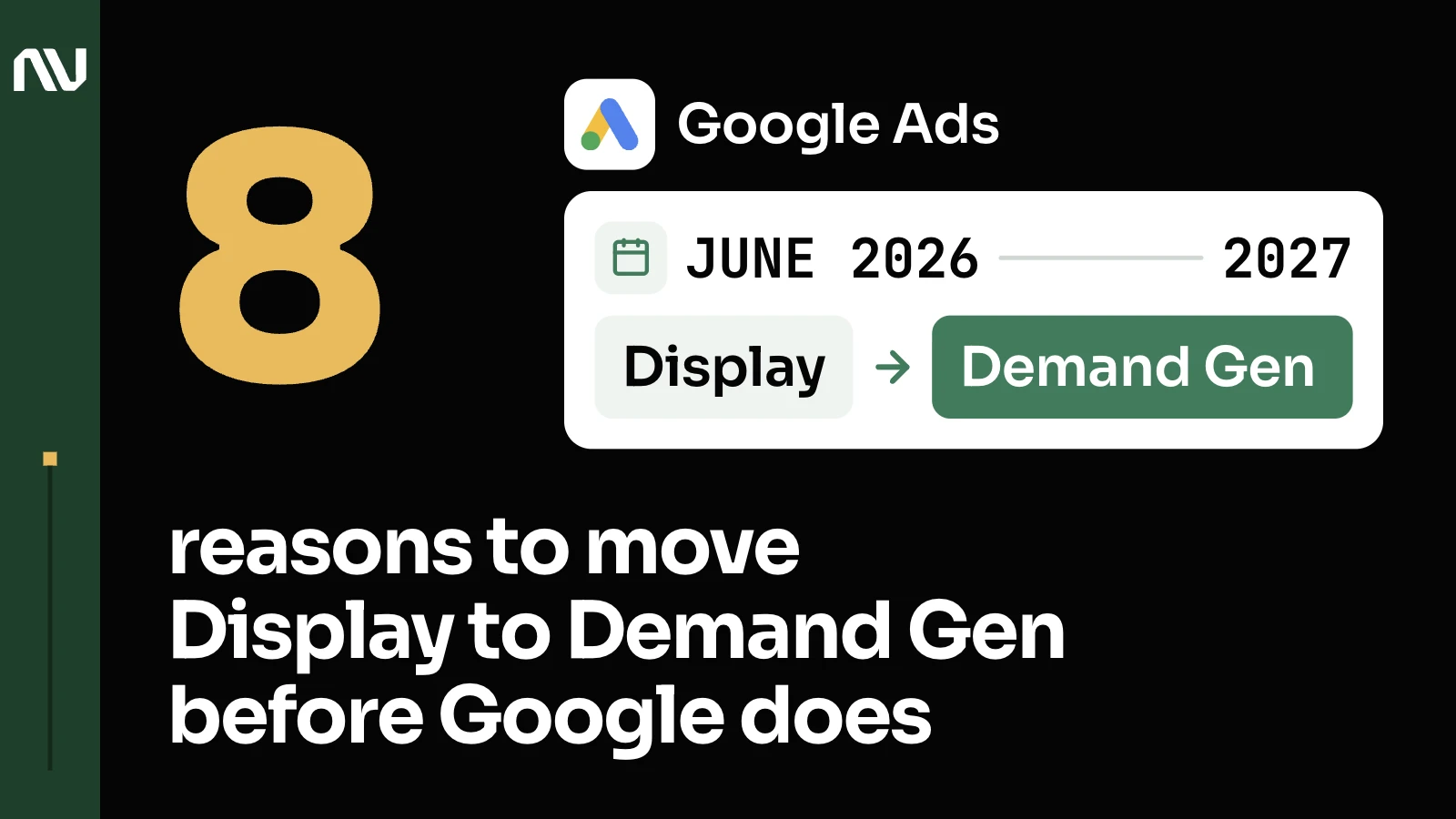
Display is getting the same treatment, on a published clock: Google is running “a phased rollout of our migration tool” starting June 2026, after which new Display campaigns can only be created inside Demand Gen, and Google says the whole move is “expected to complete by 2027.” It’s one more move in a pattern that’s been building across the platform for a while.
2. Move now and you keep control of the timing and the name.

But when we did, we also created the foundation for future scaling. If we ever had this conversation, we actually ended up having it. So this is just to say that we prepared, and it’s not going to be an issue moving forward.
Wait, and Google reorganizes it for you instead: migrated campaigns get renamed with a “[Original campaign name] #2” suffix, and the original campaign flips to “Removed” status, kept around for reporting but no longer the one you built.
3. Demand Gen adds YouTube, Discover, Gmail, and Maps to the Display Network’s reach.

During the year we did this research, the marketing mix model, and we discovered during that effort that the demand generation campaigns actually have very high influence on brand consideration and view through conversions. Meaning people see a demand generation ad on YouTube, for example, or somewhere on the Google Discovery feed or other placements, and sometimes they don’t necessarily convert straight away. But we use that research to see a correlation between reach that we have within demand gen and the business effects that it has on other campaigns. So we use that research to revamp demand generation campaigns. This is a top funnel campaign that is designed to create that brand awareness, brand influence that is then converted into brand search and direct visits to the website.
Google frames this as the point of folding Display in: a single campaign type that reaches “Google Display Network (GDN) inventory alongside YouTube, Discover, Gmail, and Maps (in Beta).” That’s the shape of a full-funnel Google Ads account already, just folded into one campaign type instead of several.
4. Google’s own numbers show adding GDN to Demand Gen lifts ROI by 9.5% on average.

Because I do believe that the media efforts that we have have a direct influence on this trend right here. Even though this specific trend is hard to pinpoint directly, because as I’ve said, people see an ad, a video ad, and very few of them go and buy after seeing it. It may take some time for them to go to search and then decide. But since we are indeed growing and there is more brand traffic, there is more revenue, I do think that this small media campaign, the demand generation campaign, the video campaign, is having an incremental influence on this area.
Google has now put a number on that hard-to-isolate lift: “On average, advertisers adding GDN in Demand Gen campaigns see a 9.5% increase in ROI.” That’s exactly the lift proper incrementality measurement is built to catch in the first place.
5. GoFood, Google’s own case study, cut CPA 24% and grew conversions 19% making this exact move.

I’m a very picky person, and I love expertise, I love results. I love seeing how things work before I make any serious commitments to anything. And that is my approach to many things.
Google has a named example: “food delivery platform GoFood saw a 24% decrease in CPA and 19% higher conversion volume by adding GDN.” That’s Google’s own case, not ours, and it is exactly the proof I want to see before I recommend a change.
6. Demand Gen reports performance broken out by format, a view standalone Display never gave you.

I think there is a way to have a quality score report. There is a script that creates a snapshot of the quality score across the account, and then we compare before and after. There is also this metric you can include in the columns that is called historic quality score. So when you add historic quality score, and a period of time, let’s say January versus December, historic quality score will have this breakdown between the time frames. Because if you just add the quality score as a column, it just reports the quality score as is at this time. But QS hist, it stands for a more in depth time breakdown.
Demand Gen does the same thing for creative format: “format segmentation reporting” that gives you insights “broken out by format level,” instead of one blended number for the whole campaign.
7. Demand Gen can target Lookalike segments, a feature standalone Display has lacked since 2023.

I think that you have great and literally unique selling points that needs to be highlighted there in the ads. Just to pick information up from the website and display there in the ads instead of just generic information. On an intersection of the structure and communication, Performance Max, even though it’s structured relatively well, it can use at least two things. I don’t know how familiar are you with how PMax works, but it doesn’t use the audiences, it uses audience signals, which is you provide it with data and then PMax decides where it can find more of the users of this kind. And you need to provide certain audience information to this campaign.
Google’s version of that same logic sits inside Demand Gen’s Lookalike segments, built from your own “seed list” of real customers. Standalone Display has had nothing like it since Google “no longer generate[d] similar audiences” back in 2023.
8. Demand Gen folds Display into the same streamlined workflow as the rest of your upper-funnel campaigns.

So this is one structural thing, and then the other, you have a video on the website, which is a good video, but I think it could be repurposed in at least three ways, maybe even six because of the aspect ratio. So you have, I think, a 30 seconds or maybe 40 seconds video on the about page, which can be sliced into five 15 seconds clips, shorter clips, and then it could be resized because this is like horizontal video. And most of the users on YouTube, for example, maybe 80% of users on YouTube, they are watching videos from their phones. So this same video that you have could be repurposed in multiple ways just to get you more coverage, using better audience signals, using better ads. The same ad just repurposed in a way that the platform accepts, should have a better shot.
Fold Display into Demand Gen and the same automatic defaults already cover the new campaign, the way Optimized Targeting turns itself on for you by default too, inside what Google calls “more streamlined campaign management.”
Moving yourself takes a few minutes, and the budget resets the moment you do.

The tool for this rolled out to advertisers starting June 2026, inside your account, a few clicks against the campaigns you pick. Google’s own numbers say relearning is short, “approximately 1-2 days,” though whatever budget you’d already spent that day resets to full the moment you flip the switch, so picking a quiet day avoids a scramble.
We usually work with companies who already have something going. They have a working engine, and this engine is optimal. For situations like this, it’s very easy for us to come in, to figure out what’s working, what’s not, to make data driven predictions, and show meaningful progress within the first 30 days, to a business owner, so they can see our attitude, our expertise, the level of depth. And for us, it’s a way to learn the business even more and provide value, because I do believe in offering value, and that’s the way I do things.
See how Demand Gen fits into the rest of a Google Ads account, or if you’d rather have someone else drive the move, get in touch.