Here’s the trap most bootcamps walk into with Google Ads. They turn on campaigns, leads start coming in at a cost-per-lead that looks great, everyone’s happy for about six weeks. Then the cohort opens, the seats don’t fill, and nobody can explain why the “cheap leads” didn’t turn into students who actually paid $12,000 and showed up.
The cost-per-lead was lying the whole time. Google was optimizing toward the thing you told it to count, which was form fills, and form fills are the easiest, lowest-value action in your entire funnel to manufacture. So that’s what you got. More of the cheapest thing.
This is the core problem with running Google Ads for bootcamps, and it’s why the playbook for a high-ticket, cohort-based program looks almost nothing like the playbook for a $40 ecom product. You’re selling a $5,000 to $20,000 decision that someone takes weeks to make, often involving financing or an income-share agreement, usually after a webinar or a call. The money doesn’t arrive when the form gets submitted. It arrives 3 to 8 weeks later, if it arrives at all.
This guide is the full system we use to run paid acquisition for bootcamps: why you bid on enrollments instead of form fills, how the channels split the work across a cohort timeline, how to track a sale that lands weeks after the click, how to handle the “AI killed coding jobs” objection in your creative, and where Performance Max fits (later than Google’s rep will tell you). It maps to the way we think about every account, which is three pillars: conversion tracking, account structure, and communication strategy. Tracking first, because everything else is built on top of it.
Why cost-per-lead is the wrong number for a bootcamp
Smart Bidding is good. It will reliably get you more of whatever you optimize for. That’s exactly the problem. If you feed Google “form submission” as the conversion, it learns who fills out forms, and it gets very good at finding those people cheaply. People who fill out forms and people who pay $12,000 for a 16-week program are not the same population, and the gap between them is where bootcamp budgets quietly die.
The form submit is the start of the conversion, not the end. For a bootcamp the real conversion is an enrollment, a paid deposit, an accepted offer. That event lives in your CRM or your application system, not in the ad click. So the number that actually matters, cost-per-enrollment, isn’t even visible in your Google Ads account by default.
What you want to optimize toward is lead quality, and the only way Google can optimize toward quality is if you send the quality signal back. In lead-gen accounts where the form fill is the primary conversion, we routinely see the algorithm chasing volume that never closes. The fix is offline conversion tracking, which we’ll get to. For now the mindset shift is the whole game: stop counting how many people raised their hand and start counting how many people enrolled.
The lead-quality lag is real, and it changes how you manage budget
There’s a second trap underneath the first one. Because the money lands weeks after the click, the temptation is to manage the account on today’s numbers. Leads are up today, so increase budget. Leads are down today, so pull back. We’ve watched businesses run their whole budget this way, hand-managing it off yesterday’s activity, stuck in feast-and-famine cycles where nobody can reliably predict the next cohort.
When the revenue actually attributes to a lead 2 to 3 weeks later, daily budget tweaking is the wrong lever entirely. The thing to watch is the quality of the leads you’re getting today and the cost you’re paying for them, then let the closing data confirm or correct the picture a few weeks on. That’s a calmer, more accurate way to run it, and it’s only possible once the tracking can see across that gap.
Pillar 1: conversion tracking, the ceiling on everything else
I’ve never met one bootcamp, or any client, whose conversion tracking was perfect when we started. Not one, and I’m serious. It’s not that it’s impossible. It’s that it gets technical fast, and that’s exactly why most advertisers stop at the basics. The basics are where the gap is.

A conversion tab that returns “1 form submission” once in a while is not conversion tracking. Here’s the stack a bootcamp actually needs, built bottom-up, because advanced features stacked on a broken base just amplify bad data.
Track the enrollment, not the form fill, with offline conversion tracking
This is the single highest-payoff thing you can do, and almost nobody does it. Offline conversion tracking (OCT) imports the outcome of a lead back into Google Ads. When an application gets accepted or a deposit gets paid, you send that event back, tied to the original click ID, so Google learns which clicks become students.
The mechanics: capture the GCLID (Google’s click identifier) when someone submits your application form, store it against that person in your CRM, and when their status changes to enrolled, upload that conversion back to Google with its value. Now Smart Bidding optimizes for enrollments, not form volume. You can read Google’s own walkthrough in the offline conversion import documentation. For a high-ticket program this isn’t optional. It’s the difference between bidding on the right outcome and the wrong one.
One nuance for long cycles: Google’s conversion window caps at 90 days. If your sales cycle from first click to paid enrollment regularly runs longer than that, optimize toward an earlier high-quality stage (application submitted, sales call booked, deposit paid) instead of the final payment, so the signal lands inside the window.
Recover the conversions you’re already losing
Before you do anything clever, plug the leaks in what you have. Client-side tracking alone loses a real chunk of conversions to ad blockers, consent rejections, and cookie expiration. Two fixes do most of the work:
- Enhanced Conversions. This sends hashed first-party data (email, phone) along with the conversion so Google can match it to signed-in users it would otherwise miss. It supplements your pixel, it doesn’t replace it. Google’s Enhanced Conversions documentation covers setup; email and phone alone cover most of the value, so don’t stall the launch waiting on full address data.
- A solid foundation underneath. The Conversion Linker firing on all pages so click IDs get stored, a stable transaction ID on every enrollment so you don’t double-count refreshes and back-buttons, and data-driven attribution so your upper-funnel and mid-funnel touches actually get credit instead of last-click eating it all.
None of this is glamorous. Transaction IDs and the Conversion Linker are not exciting. They’re also the reason your numbers either match reality or don’t. A single missing or unstable transaction ID is one of the most common reasons Google’s reported conversions wildly exceed what actually happened in your backend.
The honest test: do your reported conversions match your CRM?
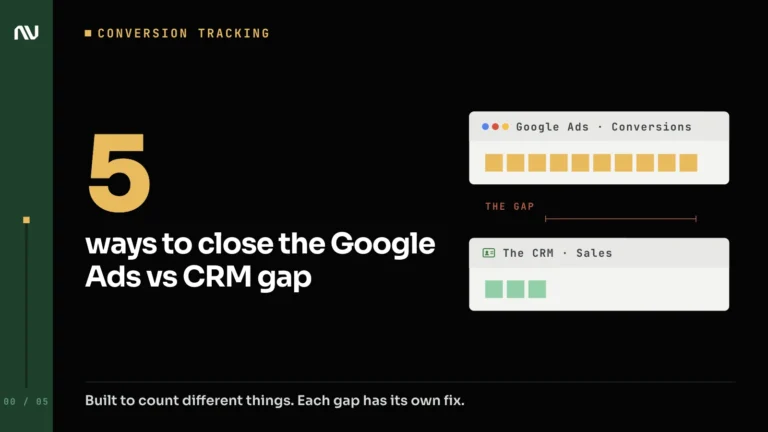
Here’s the check you can run today. Pull what Google Ads says you got last month and pull what your enrollment system says you got. If the volume is off by more than about 10%, or the values by more than 15%, your tracking is broken and every optimization decision sitting on top of it is suspect. That’s the whole point of this pillar. The better the signals you send Google, the better the result. Simple as that.
We go deeper on this in our guide to conversion tracking for online course businesses, and the same principles run a level deeper in our breakdown of why your school’s revenue depends on proper tracking. A bootcamp is an online course business with a deadline attached, so it all applies, just with higher stakes per enrollment.
Pillar 2: account structure, and cohort pacing across channels
Once tracking can see enrollments, structure is about putting the budget where it does the most good at each point in a cohort’s life. This is where bootcamps differ most from evergreen products, because you’re not selling something available forever. You’re selling seats that open, fill, and close on a calendar.
The channel split: Meta builds the pipeline, Google search captures the deadline
Think of it as two different jobs. Most of your future students don’t wake up Googling your bootcamp’s name. They don’t know it exists yet. Demand-creation channels, Meta and YouTube, are how you put your program in front of people who weren’t looking, build awareness over weeks, and fill the top of the pipeline ahead of a cohort.
Google search does the opposite job. It captures demand that already exists. When someone finally searches “data analytics bootcamp” or “is [your program] worth it,” they’re far down the consideration path, often right at the deadline. That’s the moment search ads are worth the most. So the rhythm across a cohort looks like this:
- Early in the window: lean into Meta and YouTube to build the pipeline. You’re creating demand and seeding a remarketing pool you’ll harvest later.
- Mid-window: nurture. Retarget the people who watched the webinar or visited the page but didn’t apply. This is where most of your warm pipeline actually converts.
- Closing days: push search hard and hit your remarketing lists with the deadline. Capture the people who’ve been circling for weeks and are now searching with real intent.
If you judge your Meta and YouTube spend by the same last-click cost-per-acquisition you expect from search, you’ll kill the exact channels that filled your pipeline, then wonder why search has nobody warm left to capture. Demand creation and demand capture run on different physics. Upper-funnel CPAs run higher by design, and a lot of their impact shows up as view-through influence and as branded searches later, not as a direct click-to-enroll line. We unpack the prospecting side of this in our piece on the 80/20 of running Facebook and Instagram ads that scale.
Search structure: consolidate, don’t fragment
On the search side, modern Google Ads is won by consolidation, not by the old habit of one keyword per ad group. Smart Bidding optimizes at the query level, so the more query data you feed each campaign, the faster it learns and the lower your marginal cost-per-enrollment. For most bootcamps that means a tight structure: a few consolidated campaigns grouped by message, broad match paired with conversion-based bidding (the enrollment signal you wired up in pillar 1), and strong responsive search ads that speak to where the prospect is in their decision.
Two things bootcamps specifically need to get right:
- Defend your brand search. Once your Meta and YouTube spend works, people start searching your bootcamp by name. A branded search campaign protects that traffic, controls the landing page, and stops your other campaigns from quietly claiming credit for demand they didn’t create. It’s cheap insurance and it keeps your numbers honest.
- Separate brand from non-brand in your reporting. If branded and non-branded enrollments sit in the same bucket, your true cost to acquire a new student looks far better than it is, because you’re crediting people who already knew you. Pull them apart so you know what cold acquisition actually costs.
Pillar 3: communication strategy, the offer and the objections
An ad is an amplifier. If your offer is unremarkable, a bigger budget just means more people find out it’s unremarkable. No bidding strategy fixes a weak offer. For a bootcamp the offer and the landing page are where most of the results are actually won or lost, and they’re usually the part people spend the least time on while they obsess over bid settings.
Sell the outcome and answer “why now”
Your prospect is asking four questions, whether they say them out loud or not. Is this worth it? Why you over the other ten bootcamps? Why now? And what if it doesn’t work for me? A strong bootcamp offer answers all four.
- Worth it: sell the transformation, not the syllabus. “Become a job-ready data analyst in 16 weeks” beats a feature list of modules.
- Why you: your differentiator has to survive without mentioning price. Outcomes data, a specific hiring-partner network, a teaching method, a narrow specialization. If the only answer is “we’re cheaper,” that’s a commodity, not an offer.
- Why now: this is the bootcamp’s natural advantage. Cohorts give you real urgency. A genuine application deadline and a limited number of seats are honest scarcity, and honest scarcity converts. Faked countdown timers do the opposite; they read as sleaze and cost you trust.
- What if it fails: this is where financing, ISAs, and job guarantees do real work. They’re risk removal. They move the decision from “can I afford to be wrong” to “I’m protected if it doesn’t pan out.” Make these prominent, not buried in an FAQ.
Handle the “AI killed coding jobs” objection head-on
If you run a coding, data, or tech bootcamp in 2026, there’s an objection sitting in your prospect’s head before they ever click: “Isn’t AI making these jobs obsolete? Why would I pay $15,000 to learn something a model can do?” Pretending it isn’t there doesn’t make it go away. It just means the objection wins in silence.
Put it in the creative. The honest, confident answer is that AI raises the bar on judgment, it doesn’t remove the need for people who understand the fundamentals. The cliché version is “AI just lets people do stupid things faster.” It makes weak practitioners worse and strong ones far more productive. A bootcamp’s pitch in this environment isn’t “learn to code.” It’s “become the person who can direct these tools, debug what they produce, and make the call on what’s actually correct.” Naming the fear and answering it with a specific, credible frame converts better than any landing page that pretends the question doesn’t exist.
Then amplify with creative and video
Once the offer, the page, and the tracking are solid, that’s when production pays off. Student outcome stories, instructor explainers, short-form video that hooks in the first 5 seconds and brands early so even the skippers know who you are. We build the foundation first, then build the creative and video that carry a strong offer to a cold audience. Done in the other order, you’re producing beautiful ads pointing at a funnel that leaks.
Where Performance Max fits (later than you think)
Google’s reps will push Performance Max early, because it spends. For a bootcamp, PMax before your tracking is wired is close to setting money on fire, because PMax is a black box that flatters itself. It eats your branded search and counts it as new acquisition, it over-credits remarketing, and it hides where the money actually went. If it’s optimizing toward form fills instead of enrollments, all that opacity is now working against you at scale.
The sequence that works:
- Get enrollment tracking live and verified against your CRM (pillar 1).
- Build clean, consolidated search and a defended brand campaign (pillar 2).
- Build your offer and creative so the funnel actually converts (pillar 3).
- Then consider PMax, with enrollment as the conversion goal, your brand terms excluded so it can’t claim demand it didn’t create, and a real cost-per-enrollment target instead of “maximize conversions” on form fills.
PMax can absolutely contribute for a bootcamp. The order matters. Whoever controls the inputs controls PMax, and you can’t control the inputs until the tracking underneath them is clean. We dig into the broader version of this failure pattern in our breakdown of why scaling PPC fails and how to fix it.
How it fits together: the bootcamp acquisition system
Pull it up a level and the whole thing is one system, not a pile of tactics.
Track enrollments, not form fills, so every decision downstream is aimed at the right outcome. Pace the channels to the cohort, using Meta and YouTube to build pipeline early and search to capture the deadline late. Win on the offer and the objections, because the ad only amplifies what’s already there, and the “is this still worth it in the age of AI” question has to be answered out loud. Add PMax last, once the signals it eats are clean.
Each of these opens into its own deeper topic: the mechanics of offline conversion tracking for application funnels, the cohort-pacing calendar in detail, the webinar-to-enrollment measurement problem, and the creative angles that beat the AI objection. Those are the next layers down from this one.
If you’re running a bootcamp and your cost-per-lead looks great while your cohorts don’t fill, the lead number is the thing lying to you, and it’s fixable. The work isn’t glamorous and it isn’t fast, but it’s the boring foundation that makes everything you spend after it actually count.