7 Reasons Ecommerce Brands Should Switch From ROAS to POAS

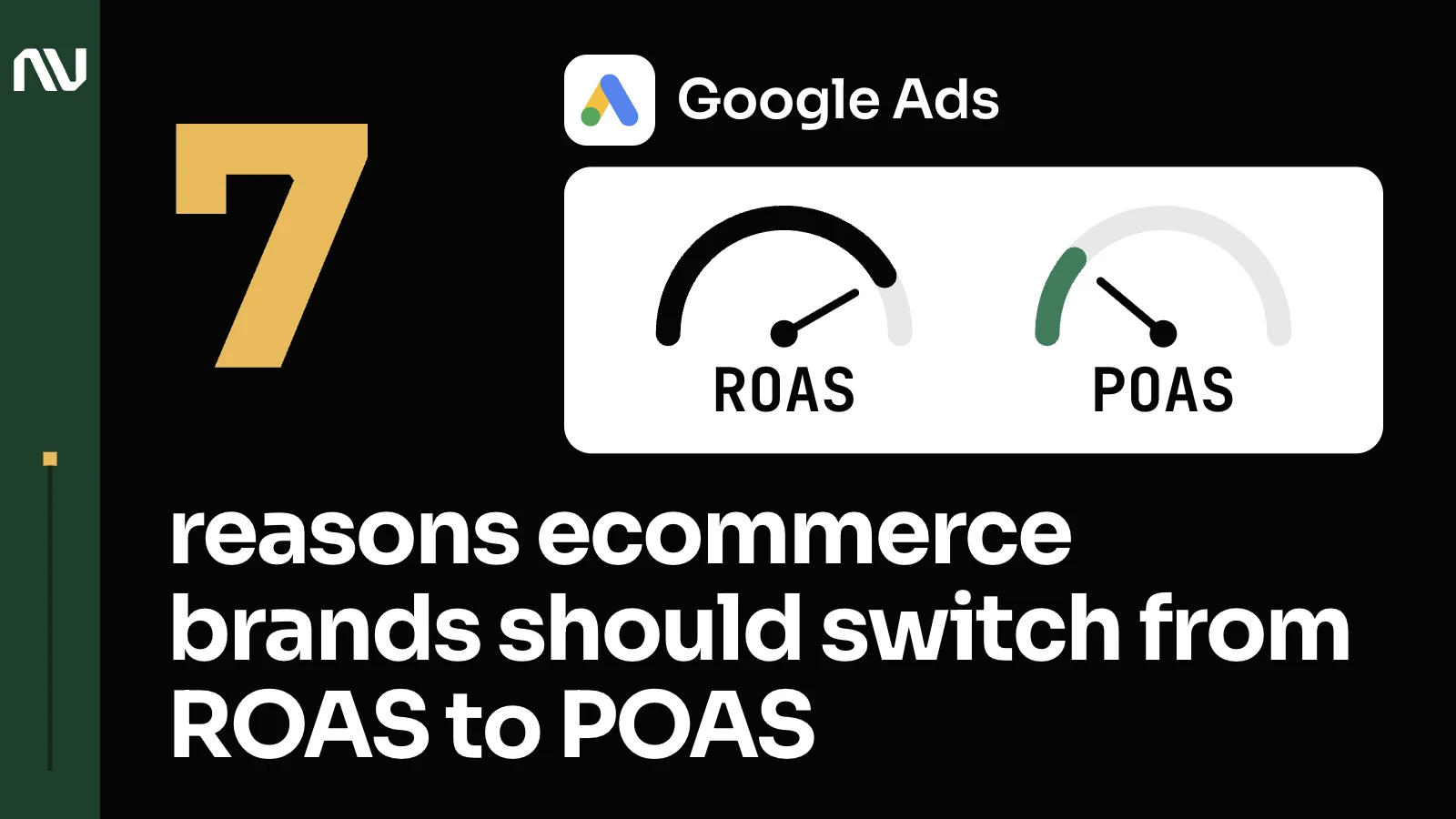
ROAS tells you how much revenue came back. POAS tells you whether any of it was profit, and for a catalog with mixed margins, those are two different answers.
1. ROAS treats every dollar of revenue the same, so a high ROAS can still sit on top of months with no real profit at all.

We were breaking even for an extended period of time or even losing. So there was no profit. And I’m mostly thinking about, okay, what can we do to shorten that period as much as we can, meaning to prioritize profit even if it’s not very big, as fast as we can. That is my way of thinking. ROAS will not flag that on its own. Seeing it takes a GA4 ecommerce dashboard that surfaces this.
2. What counts as a good ROAS moves with the scale of your account.

I would like to maybe explore ways how this may work, because at the scale of operations that you mentioned, it makes sense. But maybe at a bigger scale, the return on ad spend can be lower. Which is why I asked about revenue, because volume can get you to the profits that you expect. A ratio that looked fine at one size can be the wrong signal at another, which is really a question of which metric actually drives growth.
3. Growth and efficiency are a real trade-off that you cannot bid your way around.

That’s the key thing that we need to decide because it’s always a balance between these two values, the growth and efficiency. Usually when growth is the main priority, efficiency suffers. It’s like with building muscles, for example. When you’re building muscles, you’re also getting some fat as you work out and you can’t do the fat burning and muscle growth at the same time. So that’s the logic behind that. And that’s an important thing to figure out.
4. The revenue your ROAS is built on is often not the real number to begin with.

So the revenue, the total thing that is visible there, it’s not a real thing. So there is a lot of extra things that needs to happen to see the real thing. Shipping, payment fees, taxes, and returns sit inside that same gap, which is exactly why some brands end up warehousing margin and cost data outside the ad platform entirely.
5. Add up what every platform reports and you can end up counting the same sale twice.

The point with the platform is that it sees much more touch points than we do. And it is able to say with precision if the platform participated in the purchasing journey in general. So the platform reports a ROAS, which is relatively high. But what it means is every time when there was any interaction from Facebook, Facebook attributes this conversion back to it. And when we look at the raw data, Facebook contributes a lot at the top of the funnel.
6. When growth and efficiency conflict, prioritizing profit is the discipline that wins.

So if at some point we’re hitting a plateau and we are still at the return, that spend mark, it’s going to be better than if we’re growing the revenue, but the return net spend is dropping. Prioritizing profits and prioritizing efficiency is always better than prioritizing growth at the expense of efficiency. That’s also why a declining ROI doesn’t always show up in ROAS until the plateau is already behind you.
7. Running campaigns against a margin target, instead of a plain ROAS number, is already something real accounts do.

We are currently struggling with the same thing, the traffic from people who already know the brand. Branded traffic is converting well. For example, if we look at Google, all of the branded campaigns they operate at and above the margin target. But the cold campaigns, the ones that are aimed at people who are not aware about the brand who encountered for the first time, just having lower rate of return.
Google’s own page puts it plainly: “With Target ROAS, bids are set to maximize conversion value, such as sales revenue or profit margins, while trying to achieve your target return on ad spend (ROAS).” That is the actual definition of the strategy, which only works once you have conversion tracking set up to carry profit as well as revenue.
What to do with this

Keep ROAS in your reports if it helps you talk to a board or a bank. For deciding where the next dollar of ad spend goes, profit is the number that matters.
If you sell physical product and want a second look at whether your bidding is chasing revenue or profit, here’s how we work with ecommerce accounts. Or reach out and we’ll walk through your account together.