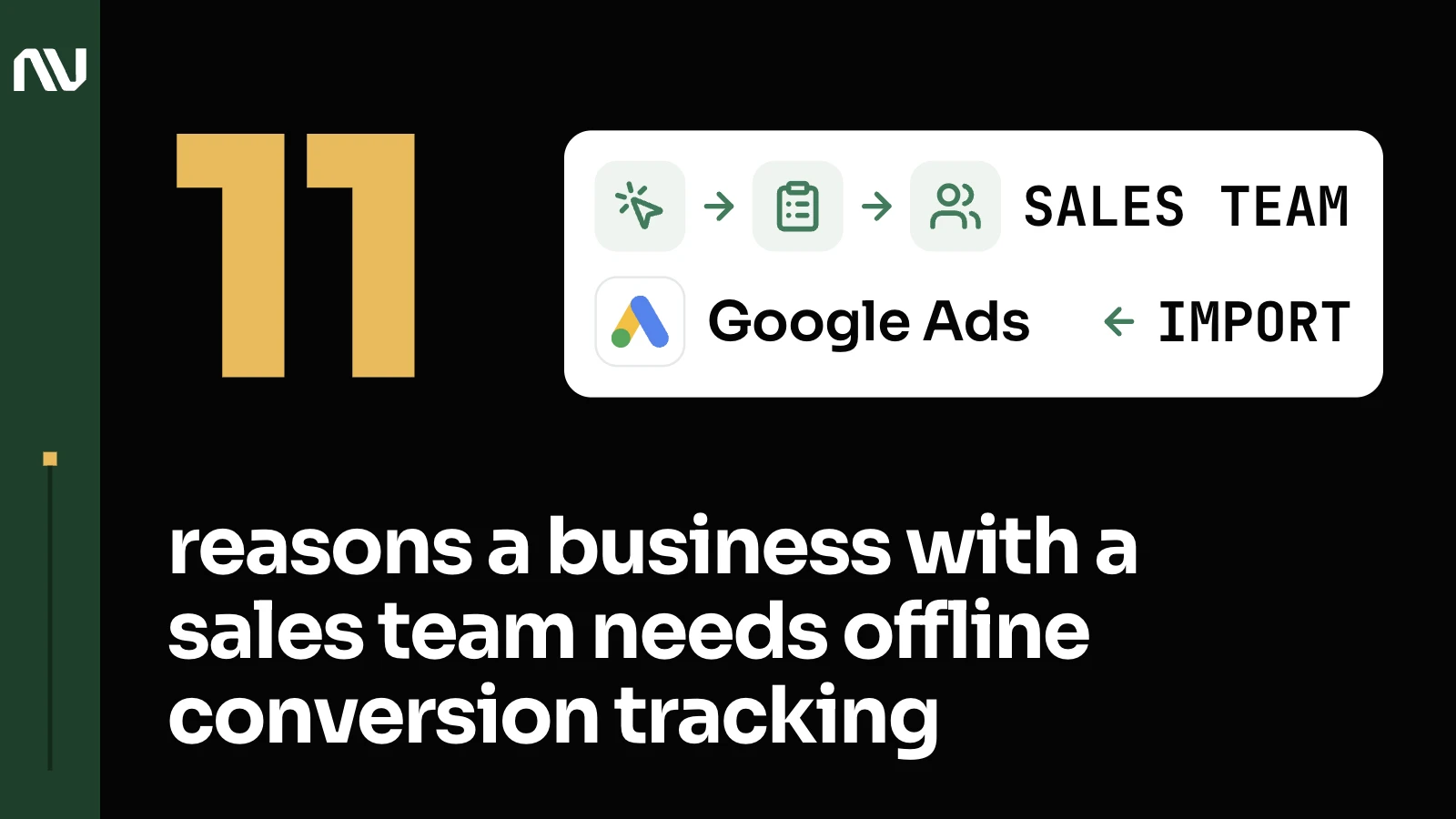
11 Reasons Every Business With a Sales Team Needs Offline Conversion Tracking

A business owner, a manager of a company, was handholding the Facebook budget and making decisions based on yesterday’s sales numbers. It may sound strange, but that’s how they rolled. They were experiencing huge issues with that: results were hit and miss, and they couldn’t reliably fill the sales pipeline.
When we came in, we implemented the tracking framework. At some point we were able to say: there is a decision lag. The revenue you get is usually attributed to leads within a matter of 2 or 3 weeks. So daily budget management is not the way to do that. What we need to focus on is the quality of these leads today and the cost we are paying for the leads.
If your sales team decides who’s a real customer after the click, your ad platform needs that same information, or it’s bidding on guesswork.
Offline conversion tracking sends that same signal to Google instead of leaving it in your head.
1. A web form tells you someone was interested. It doesn’t tell you if they bought anything.

What we can help you with is help you track events, like purchase events, for example, or form submission events, so that you can use this data to instruct the platforms about what it is that you’re trying to optimize for. Put it very simply, you need to tell exactly what it is that you’re trying to do. The web event that is being recorded with a platform pixel on your platform, the accuracy of that event determines the accuracy of your marketing efforts moving forward. Because if it’s not done properly, you will just get all sorts of things, like all sorts of results and traffic without any chances.
For a business with a sales team, that judgment happens on a call or in a follow-up, whether it’s a contractor’s call center or a bootcamp’s admissions team.
2. When the only signal you send back is “form submitted,” Smart Bidding chases more of the cheapest leads instead of the best ones.

You had this experience with ads where you got a lot of leads that were very cheap, but only 3 of them ended up being qualified leads. The first question was: what is your preferred cost per lead? But then I understood that it’s probably not the right proxy. I was curious if you have an estimate of a cost per deal, a cost per qualified lead.
This is a tool that allows us to instruct the algorithm, instruct the system, what we want it to do. It is working on the back end. Just saying this is a conversion, and the more accurate we are in making these statements and giving it back to the algorithm, to the system, the more accurate the system will work. The better the signals can be transferred to Google, the better the result. Signals are things that you want to open up. Simple as that.
3. Deals that close weeks or months after the click need a proxy stage that lands inside Google’s import window, not one you only check at quarter-end.

I know that in the B2B sphere the decision making cycle is quite lengthy, and the maximum number of days that could be used to attribute conversions is 90 days.
The window gets even tighter for a long bootcamp sales cycle: here’s what to bid to instead when the close lands outside it.
4. The number that should reach Google is what that lead turned out to be worth, not how many form fills came in.

The best way to go about this is to review the actual data from the CRM: see how long it takes for people to convert from a lead to a marketing qualified lead, to an opportunity, and then to a customer, and apply it based on your real sales data from the sales team, from the CRM. The customer is probably the most important stage of all.
The first thing that I need from you is the goal alignment. This is something that we start with. If you have the target, that gives us an estimate of the average budget that we need to allocate to this platform.
5. Two submissions from the same lead should count as one conversion, or the algorithm learns from a number that’s inflated.

In terms of the application of these conversions on the campaign level, all of the active campaigns are using appropriate conversions, which is good. This is also a good thing: each conversion is set up to be counted only once. You don’t want someone submitting their lead application a few times and counting it every time. You’re only counting it once, which is the right way to do it. This is something that needs to be revisited, to make sure this is deliberate.
6. A blended GCLID-plus-hashed-data import recovers matches a click-ID-only setup quietly loses.

We are now working on fine tuning the conversion tracking. There’s going to be a few requests that we will be doing to the dev team. Google now wants us to send some additional hits to improve the offline conversions, meaning emails and phone numbers. We will be hashing them so the platform will not receive the real ones. But to have a better match rate on the platform side, the respective tables will also need to have this information along with click IDs.
While you do have most of the important conversions set up in the account, all of them that are being used for tracking purposes get this notification that they need attention. This is an enhanced conversion tracking notification. This is something that Google is saying: that you are passing personal information, names, phone numbers, emails and other hashed data for the algorithm to optimize, but at some point some errors occurred. Maybe it’s nothing, but maybe it’s something, so additional review is necessary: how is this setup actually done between the CRM and the Google Ads account?
Google’s own guidance backs up why that layer matters: enhanced conversions for leads is “an upgraded version of offline conversion import that uses user-provided data, such as email addresses, to supplement imported offline conversion data to improve accuracy and bidding performance.” The plain offline import path on its own “doesn’t have the durability features that enhanced conversions for leads offers.”
7. Only one funnel stage can be the priority at a time, or the algorithm ends up splitting its attention between two different goals.

You optimize for the right thing. You created the campaign that is optimized for a conversion: a form submission, a quiz submission, or a purchase. You’re optimizing for the right thing.
You would always want to optimize for the thing that you want to get, and it is not landing page views. Landing page views is super high level. You will not benefit from that at all. Ideally you want to optimize for registrations and then for the form submissions. While registration runs, you’ll probably have enough of the web events for the bidding algorithm to exit the learning phase. Then as you progress, try to allocate as much budget on the exact event that you want to optimize for, which would be the purchase. Maybe allocate a little bit more to the registration event, because you probably expect to have more of them, proportionally less to the form submission, and something to the purchase. This is not set in stone. If you see some traction with a different conversion event, the budget needs to be reallocated. You just need to test that and let the data guide your decisions.
8. Even below Google’s bidding-volume threshold, tracking the offline stages tells you things your dashboard can’t.

It’s very hard to have these estimates, these generals, to instruct our strategy. It could be a lot, it could be a little. It’s impossible to use these insights without seeing what’s on the back end: the CRM, the business model, and how all of those components work together.
That’s true even below the volume Smart Bidding needs to learn from. The signal still has a job, just for a person instead of the algorithm.
9. Checking Ads-reported conversions against the CRM once a month catches tracking drift before it costs you a quarter’s worth of bad decisions.

I want to make sure that I have the full picture as to how all of this reconciled, because there are more than one way to measure all of it.
Pull the CRM total and the Google Ads total side by side once a month. We’ve written about why those two numbers disagree in the first place.
10. Most accounts don’t need a smarter bid strategy. They need about 30 clean, verified conversions a week so the strategy they already have can learn.

It’s good to make sure that all of the aspects of a conversion setup make logical sense. We usually do a conversion map so that technical and non-technical people can figure out what means what, and stay mindful about what we’re trying to optimize for. With auto bidding, the rule of thumb is that you need to generate something like 30 conversions per week for automated bidding to work properly. At the current level of data acquisition, that’s just not feasible, so it needs to be aggregated at a different level. Each of these events needs to be reviewed to make sure all of them make sense.
Google these days is working mostly on automated bidding, and there are minimum thresholds for the bidding algorithm to be predictable. With that economics, the standard approaches are not as applicable. It doesn’t mean there are no ways to go about this, but in the accounts we manage, at least 30 conversions a week is the number that keeps things predictable, and that’s not feasible for every market. These are constraints that are important to keep in mind while managing the account.
11. Nothing you track means anything until you and your sales team agree on what a qualified lead and a closed deal actually are.

I can present the average cost of click, the minimum, the maximum. We will be paying something in between. The conversion rate, how many leads we will actually get, will be an estimate. I will make the research, the keyword research, some other things, to make an educated guess around that, and send it your way. We don’t know before we start running it, but it’s part of the calculation, and it’s going to take some time before we find the keyword, the ad, the offer on your landing page that converts into the deals, the volume of deals and the cost of deal that you’re looking for.
We have to agree on that. That has to be the step zero before we commit to anything. I’m being transparent: this is what I see, this is the cost of traffic, this is the estimate of what I feel it’s going to be. It may not work within the first month, maybe a few months, and we need to be on the same page about that. We need to be aligned on this. If we are aligned on that, then it’s going to be very simple. We will make sure that the events that you want to optimize for, qualified leads, is being tracked properly. So we will set up tracking within the platform.
Once that agreement exists, offline conversion tracking is just the mechanism that keeps both sides honest about it.
Start with the stage your sales team already tracks

The way we work with data is unique, because we don’t use one fancy tool. We use the most basic, standard tracking capabilities that Google, Meta, GA4 and Looker Studio provide. It’s a matter of how well we plan what we want to measure, how well we execute the implementation so the measurement is accurate, and how well we structure this information in reports so it’s easy for anyone involved to see what’s going on.
After we discovered that lag, convinced everyone this is what we need to do and this is how we need to measure the cost of acquisition and quality, a few months passed and the company was in their best shape ever. They had the best month in terms of revenue, in terms of return on ad spend, in terms of efficiency. The data helped us figure out how to approach the budget, how to plan it.
Start with the one stage your CRM already tracks well: a qualified call, a signed proposal, a closed deal. If you want the full build, that’s what our conversion tracking page walks through. If you’d rather walk through your own setup first, get in touch.