10 Reasons Smart Bidding Beats Manual CPC (Once Your Tracking Is Right)

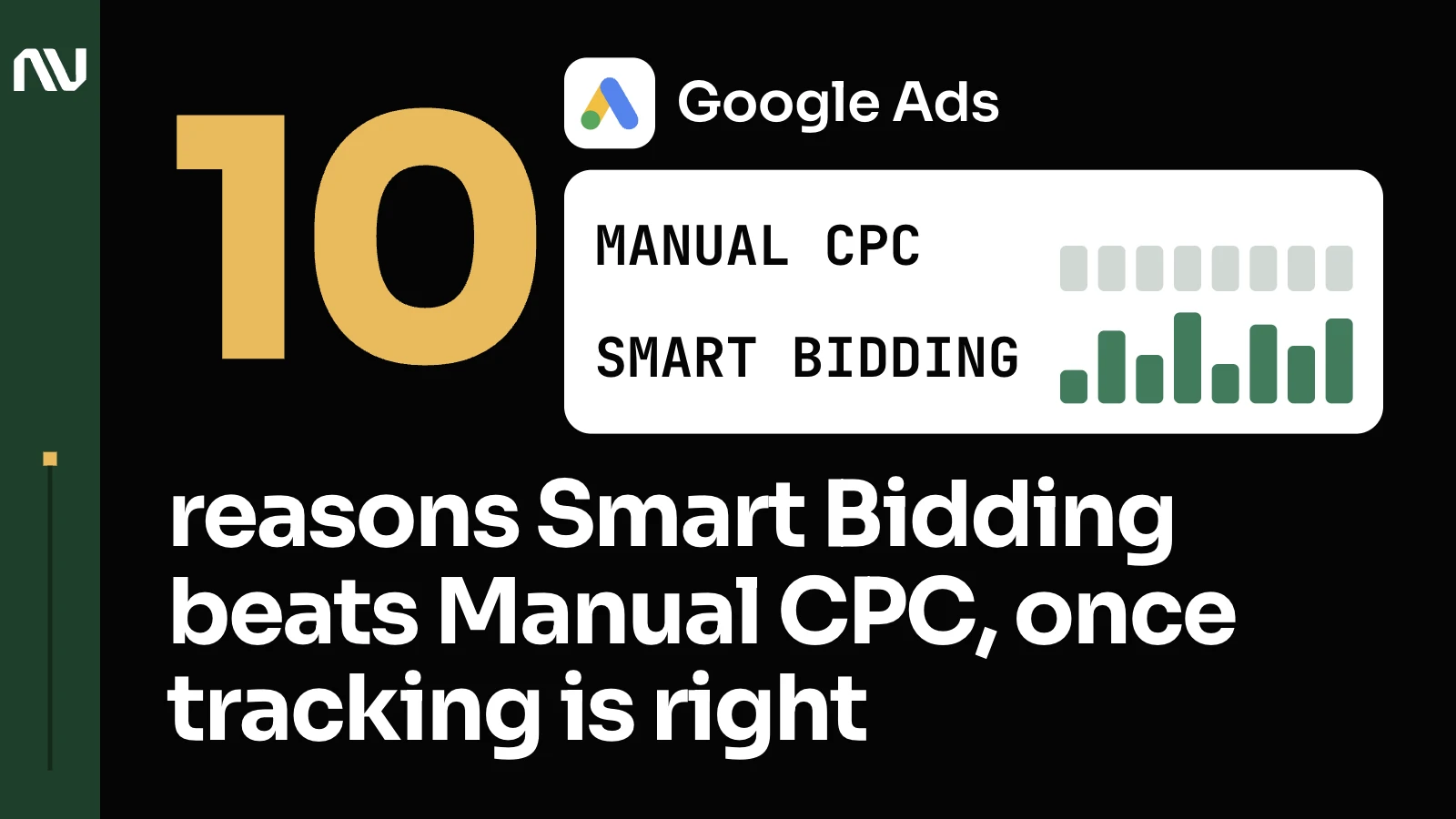
Smart Bidding beats Manual CPC in nearly every account we manage, once tracking is clean.
The better the signals can be transferred to Google, better the result. Simple as that. Without the foundation, it’s literally impossible to make this platform work.
1. Smart Bidding sets a fresh bid for every single auction, and the one real Manual CPC win people cite doesn’t change that.

Smart Bidding uses Google AI “to optimize for conversions or conversion value in every auction,” Manual CPC is just “a bidding method that lets you set your own maximum cost-per-click.” Its one real win is a branded campaign beating Target Impression Share, not on Google’s own 4-strategy list.
I was wondering why we don’t see the impression share and how we compare to other advertisers. I’m usually tracking that here, and there are highlights in the campaign tab, usually in the overview, but we don’t have them. And now it looks like Google has hidden this auction insight tab.
2. It reads signals no human bidder can track by hand.

How these campaigns behave depends on the goals. We have 3 ad groups, and the algorithm decides which ad group to prioritize. We just provide it with the target, the assets to use to achieve the target, and some other settings there. The algorithm will decide one is doing better than the other, and it will demote the one that just launched, and it will not get as much reach as you might have expected.
3. None of this works until your tracking is telling the truth.

Now you have the right foundation, which is conversion tracking, call tracking. The system already sees what it needs to see.
That’s what “clean” tracking means, and why a Google Ads and CRM mismatch breaks a bid strategy first.
4. Manual CPC has no learning period, because there’s nothing in it to learn.

“The learning period isn’t applicable to Manual CPC,” and for an automated strategy it can take “a few conversion cycles (1-2 typically) for the bid strategy to calibrate to the new objective.”
We were running the campaign for just the purchase, and the optimization, the goal that we set for the bidding algorithm, was the purchase event, the most bottom of the funnel thing that we want to optimize for. But with the budget that we assigned, it was not generating enough conversion events to move out of the learning phase.
5. It can chase a cheaper, more efficient result once the basics are working; a fixed manual bid just sits there.

We were mostly focusing on cost per lead, because after a while, once we thought we had enough volume, the next frontier was: now let’s try to make it cheaper. So we applied various settings to make it happen. It did happen.
A fixed manual bid never does that on its own; someone has to notice and change it by hand.
6. What looks like a bidding strategy failing is often just the setup getting reshuffled underneath it.

We are reshuffling things. We are cutting some of the things that work in terms of campaigns. We had one campaign working. We stop it, then we reactivate it.
Run that test on an account that’s actually stable, and the comparison gets a lot less interesting.
7. Below a certain volume, what you feed the algorithm matters more than which dial you’re turning.

These are all of the events that we see, all of the optimization events that we can see. What other event can correspond to purchase, but accumulate more events? We used a step earlier in the funnel that still generates more hits to the system.
8. Manual CPC is a standing job; Smart Bidding runs unattended across thousands of daily auctions.

The competitors that we are dealing with in the search results likely weren’t using any bid caps. So they were occupying higher positions.
9. A bid cap that doesn’t move costs you the call as well as the impression.

If somebody is very motivated to get quality service right now, they click on the first link, they see that whatever is in front of them is the right offer, and then they just talk with the salesperson: they schedule a meeting and they’re done with searching.
10. Once tracking and volume are solid, manual bidding stops being the default.

You’re already using it in some campaigns here, but manual bidding is not the right approach in 2026.
The exceptions: a brand-new account, or one defensive branded campaign.
Get the foundation right, then let Smart Bidding do the rest.

We restructured the accounts following that trend, and now we see more qualified leads. Fewer of them, because we have to pay more for traffic. But within the ad budget that we have, we’re able to capture the right people and outbid the competitors we have to deal with.
That’s the pattern across the accounts we manage, though not every problem is a bidding problem.
See how we run Google Ads management. Prefer to talk through your own account first? Get in touch.